Affirmation Cards for Anxiety and Stress: How to Use Them as Part of Your Mental Health Toolkit

Affirmation Cards for Anxiety and Stress: How to Use Them as Part of Your Mental Health Toolkit
Anxiety lies. It tells you that every worst-case scenario is imminent, that your worth is conditional, and that the ground beneath you is about to give way. Affirmation cards do not eliminate those lies, but they give your brain a competing voice — one that, with daily repetition, grows loud enough to challenge the anxious narrative and eventually reroute the neural pathways that sustain it.
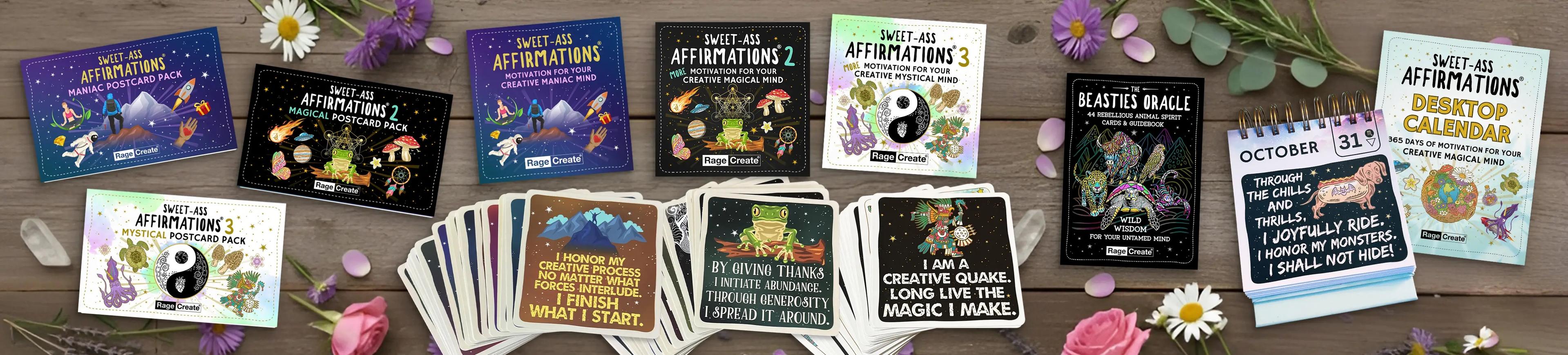
Rage Create has heard from therapists who hand Sweet-Ass Affirmations cards to clients as between-session homework, from customers who credit their daily card pull with reducing panic attacks, and from social workers who distribute cards to staff on the verge of burnout. These are not miracle stories. They are examples of what happens when a simple, science-backed tool meets consistent daily practice.
This guide covers how affirmation cards help manage anxiety and stress, specific techniques for using them during anxious moments, and how to build a daily card practice that reduces your brain's baseline stress response over time. It is important to note that affirmation cards are a complementary tool — they do not replace professional mental health treatment. If you are experiencing significant anxiety, please work with a licensed therapist or counselor and consider affirmation cards as one component of your broader mental health strategy.
For the full ecosystem of affirmation card knowledge, visit Rage Create's ultimate guide to affirmation cards.
How Anxiety Works in Your Brain (And Where Affirmation Cards Intervene)
Understanding how anxiety operates neurologically reveals exactly where affirmation cards intervene in the cycle.
Anxiety is, at its core, a threat-detection system running in overdrive. Your amygdala — the brain's alarm center — fires in response to perceived threats, triggering a cascade of cortisol and adrenaline that prepares your body to fight, flee, or freeze. In healthy doses, this system keeps you alive. In chronic anxiety, the amygdala misfires constantly, treating everyday stressors — an email from your boss, an unexpected bill, a social gathering — as existential threats.
The amygdala does not think. It reacts. And it reacts based on the neural pathways that have been most frequently reinforced. If you have spent years running anxious thought loops — "something will go wrong," "I am not good enough," "people are judging me" — those pathways are deeply grooved. The amygdala defaults to them automatically.
Affirmation cards intervene at three points in this cycle:
Point 1: They weaken the anxious pathways through competition. Neuroplasticity works in both directions. Just as repetition strengthens a neural pathway, disuse weakens it. When you replace your morning anxiety scroll with an affirmation card pull that reinforces safety, competence, and resilience, you are starving the anxious pathways of the repetition they need to stay dominant while simultaneously building competing pathways.
Point 2: They reduce amygdala reactivity through self-affirmation. Self-affirmation theory demonstrates that affirming core values reduces the brain's threat response. A daily affirmation card practice lowers the amygdala's baseline sensitivity, which means fewer false alarms, less cortisol flooding, and more cognitive resources available for actual problem-solving.
Point 3: They provide a tangible grounding tool during acute anxiety. In the middle of an anxious moment, your brain needs something concrete to anchor to. A phone full of notifications does not help. A physical card in your hand — with a specific, positive statement to read, speak, and feel — gives your brain an alternative focal point that interrupts the rumination loop and engages your motor cortex, visual cortex, and language centers in a constructive direction.
For the full neuroscience breakdown, read the science behind affirmation cards.
Daily Affirmation Card Practices for Anxiety Management
These practices are designed to lower your brain's baseline stress response over time through consistent daily use.
The Morning Preemptive Strike
Anxiety often peaks in the morning as your brain transitions from sleep to wakefulness and the weight of the day ahead lands on your chest. A morning affirmation card pull intercepts this pattern before it takes hold.
Place your deck on your nightstand. Before you pick up your phone, before you check your email, before the resistance gremlin drafts today's list of worries — shuffle and pull one card. Read the affirmation slowly. Speak it out loud. Close your eyes and feel the emotion of the statement as if it were already true. This 60-second ritual tells your brain what to focus on today before anxiety gets to make its pitch.
For the complete morning practice, read affirmation cards for your morning routine.
The Anxiety Interruption Protocol
When anxiety spikes during the day, this technique uses a card pull to break the rumination cycle in real time.
Step 1: Recognize the anxiety spiral. The moment you notice your thoughts looping, your chest tightening, or your breathing shallowing — acknowledge it without judgment. "Anxiety is here."
Step 2: Reach for your deck (or the card you pulled this morning). Hold the card in both hands. The physical sensation of the card stock engages your tactile system and begins redirecting neural resources away from the amygdala.
Step 3: Read the affirmation slowly, one word at a time. Do not rush. The deliberate pacing forces your prefrontal cortex to engage, which naturally dampens the amygdala's alarm.
Step 4: Speak the affirmation once, quietly if needed. Hearing your own voice deliver a positive statement creates a self-referential loop that contradicts the anxious narrative.
Step 5: Take three slow breaths while holding the card. Slow breathing activates the parasympathetic nervous system and physiologically counteracts the cortisol spike.
This is not about eliminating the anxiety instantly. It is about giving your brain a structured, practiced exit ramp from the spiral rather than letting the loop run unchecked.
The Evening Wind-Down
Anxiety often intensifies at bedtime when the day's unresolved stressors parade through your brain without competition. An evening card pull creates a positive bookend to your day and gives your brain a constructive focal point as you transition to sleep.
Pull a card. Read the affirmation. Speak it softly. Place the card on your nightstand face-up so it is the last thing you see before closing your eyes and the first thing you see when you wake. Your brain processes information during sleep, and the affirmation you carry into the night has an opportunity to integrate while you rest.
The Journaling Bridge: Processing Anxiety Through Cards and Writing
Combining affirmation cards with journaling creates one of the most powerful anxiety management practices available because it engages cognitive processing at a depth that reading or speaking alone cannot reach.
Pull a card. Read the affirmation. Then open your journal and write about the gap between where your anxious mind is and where the affirmation points. What is the anxiety telling you? What is the affirmation telling you? Where do they conflict? What would change if you believed the affirmation fully?
This practice externalizes the anxious thoughts by putting them on paper, which reduces their power. It also forces your brain to engage with the affirmation at an analytical level, creating connections between the positive statement and your real-life circumstances that a simple card reading does not achieve.
Explore the complete method in affirmation cards and journaling.
The Meditation Pairing for Anxiety
Affirmation cards paired with meditation create a compound anxiety-management practice that addresses both the physiological and cognitive dimensions of anxiety simultaneously.
Meditation activates the parasympathetic nervous system, lowering cortisol and calming the amygdala. The affirmation card provides a positive focal point that replaces the anxious thought loops your brain defaults to during silent meditation. For people with anxiety, silent meditation can actually increase rumination because the "quiet mind" instruction leaves a vacuum that anxiety rushes to fill. An affirmation card fills that vacuum with something constructive.
Read the complete meditation practice in affirmation cards and meditation.
How Therapists Use Affirmation Cards for Anxiety
Mental health professionals increasingly integrate affirmation card decks into their clinical practice. The applications include between-session homework assignments where clients pull a daily card and journal about their response, in-session therapeutic exercises where card pulls prompt discussions about core beliefs and cognitive distortions, group therapy activities where participants pull cards and share how the affirmations relate to their experiences, and office display where a card of the day sits in the therapist's waiting room or session space.
Rage Create's Sweet-Ass Affirmations decks are used by therapists across the country because the bold, unfiltered tone resonates with clients — particularly younger adults — who dismiss softer affirmation styles as inauthentic. One therapist described the cards as "finally, affirmations for my 30-year-old clients." Another uses them in a nursing home setting, letting staff pick a card and discuss whether it speaks to who they are.
The humor in the cards also serves a therapeutic function: laughter reduces cortisol, and the unexpected wit of a Sweet-Ass Affirmation lowers the client's defenses in a way that allows the positive statement to land more deeply than a clinical-sounding affirmation would.
What Affirmation Cards Cannot Do for Anxiety
Transparency matters more than marketing. Affirmation cards are a powerful complementary tool, but they have clear limitations when it comes to anxiety management.
Affirmation cards cannot replace medication for clinical anxiety disorders. They cannot substitute for professional therapy, particularly for trauma-based anxiety, OCD, or panic disorder. They cannot resolve the root causes of anxiety on their own — they address the symptom (anxious thought patterns) rather than the underlying cause (which may be biological, environmental, relational, or trauma-related).
If you are experiencing anxiety that interferes with your daily functioning, relationships, or well-being, please seek support from a licensed mental health professional. Affirmation cards work best as one tool within a comprehensive mental health strategy that may include therapy, medication, exercise, sleep hygiene, social support, and other evidence-based interventions.
Frequently Asked Questions
Do affirmation cards help with anxiety? Yes. Affirmation cards help manage anxiety by interrupting repetitive negative thought loops, reducing the brain's baseline stress response through self-affirmation theory, and providing a tactile grounding tool during anxious moments. They are most effective as part of a broader mental health strategy that includes professional support when needed. The mechanisms behind their effectiveness are documented in neuroplasticity and self-affirmation research.
What kind of affirmation cards are best for anxiety? The best affirmation cards for anxiety management are ones that resonate with your personality and feel authentic rather than generic. Affirmation cards that feel forced or inauthentic can actually increase anxiety by triggering an internal "that is not true" response. Rage Create's Sweet-Ass Affirmations decks work well for people who respond better to bold, humor-driven motivation than soft, clinical-sounding statements.
How often should I use affirmation cards for anxiety? Daily use produces the strongest results. The neuroplastic effects of affirmation cards compound with consistency — daily practice builds and strengthens the neural pathways that compete with anxious thought patterns. Even one card pull per day using the See It, Say It, Feel It method can create measurable shifts over three to eight weeks.
Can I use affirmation cards during a panic attack? Affirmation cards can serve as a grounding tool during a panic attack by giving your brain a tactile anchor and a focal point. However, during acute panic, your prefrontal cortex is largely offline, which limits your ability to process the affirmation cognitively. The physical act of holding the card and focusing on reading the words may be more helpful than the content of the affirmation itself in those moments. The primary benefit of affirmation cards for panic is in the daily preventive practice that reduces the frequency and intensity of panic episodes over time.
Should I tell my therapist I am using affirmation cards? Yes. Sharing your affirmation card practice with your therapist allows them to integrate it into your treatment plan, suggest cards or practices that align with your therapeutic goals, and monitor how the practice affects your anxiety over time. Many therapists actively welcome the addition of affirmation card practices to their clients' routines.
Your Brain Deserves Better Default Settings
Anxiety has had the microphone long enough. A daily affirmation card practice does not mute anxiety overnight, but it does — gradually, measurably, neurologically — build a competing voice that grows stronger with every card you pull.
Rage Create's Sweet-Ass Affirmations decks were designed for people who need their motivation bold, honest, and unfiltered. Over 3 million cards are already in the hands of creative maniacs, therapists, and humans who decided to stop letting the resistance gremlin run the show.
Pick up a deck. Pull a card tomorrow morning. And the morning after that. And the morning after that. Your brain will get the message.
Return to the ultimate guide to affirmation cards for the full roadmap. Explore the neuroscience in the science behind affirmation cards. Learn all seven daily rituals in how to use affirmation cards. See the complete benefit stack in benefits of affirmation cards.