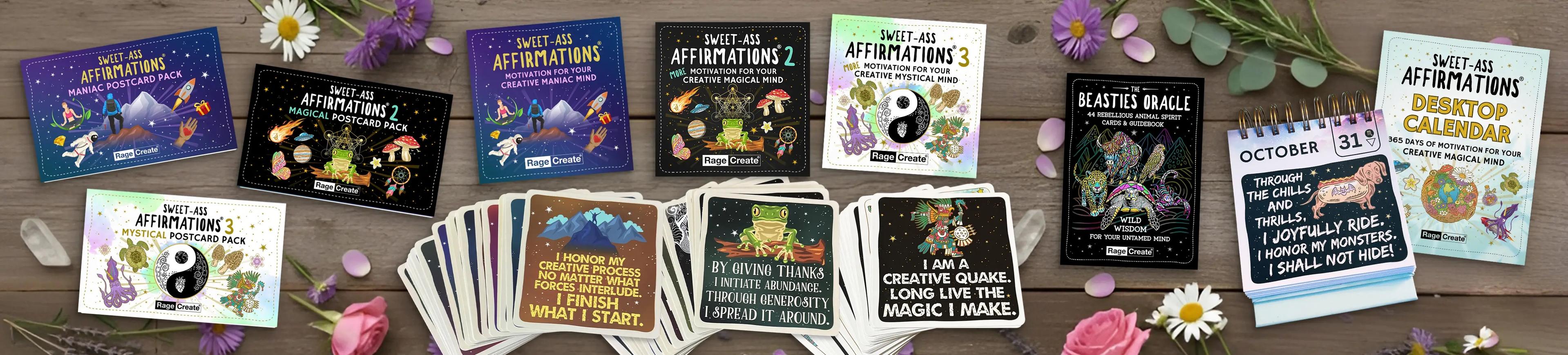
How to Use Affirmation Cards: 7 Rituals That Turn a Card Pull Into a Brain Upgrade

How to Use Affirmation Cards: 7 Rituals That Turn a Card Pull Into a Brain Upgrade
Affirmation cards only work if you actually use them, and most people use them wrong. They glance at a card, nod, set it down, and wonder why nothing changes. Rage Create has watched this pattern repeat across millions of card pulls, and the fix is not complicated — it just requires intention.
This guide covers Rage Create's core method for using affirmation cards, seven daily rituals that slot the practice into your existing life, and the mistakes that silently sabotage even the most consistent card pullers.
If you are brand new to affirmation cards, start with what are affirmation cards for the foundations. For the complete ecosystem of affirmation card knowledge, visit the ultimate guide to affirmation cards.
The See It, Say It, Feel It Method
Rage Create teaches a three-step daily practice that transforms a passive card reading into an active brain-rewiring event. This is the foundation. Every ritual below builds on these three steps.
Step 1: See It. Pull one card from your shuffled deck. Read the affirmation slowly. Do not skim. Let the words register visually. If you are using a Rage Create Sweet-Ass Affirmations deck, take a second to notice the hand-illustrated artwork, the colors, and the hidden resistance gremlin lurking somewhere in the design. The visual engagement activates your occipital cortex and starts the multi-sensory encoding process that makes affirmations stick.
Step 2: Say It. Read the affirmation out loud. Not in a whisper. Not in your head. Out loud. Hearing the words in your own voice activates your auditory cortex and creates a "self-referential loop" — your brain registers the statement as coming from you rather than from an external source. This distinction matters. Research on self-affirmation shows that first-person, self-generated affirmations produce stronger neurological effects than passively consumed ones.
Step 3: Feel It. This is the step most people skip, and it is the most important. After reading and speaking the affirmation, close your eyes for five to ten seconds and feel the emotion of the affirmation as if it were already true. Not "I hope this becomes true." Not "wouldn't it be nice if." Feel it as present reality. Emotion is the accelerant. Without it, you are reading words. With it, you are rewiring neural pathways.
The entire See It, Say It, Feel It process takes 30 to 60 seconds. That is it. Less time than scrolling through one social media feed. The difference is that these 60 seconds compound over days, weeks, and months into measurable cognitive and emotional shifts.
Understand the neuroscience behind why this works in the science behind affirmation cards.
Ritual 1: The Morning Pull
The morning pull is the most popular affirmation card ritual for a reason — it sets the tone for your entire day before the resistance gremlins have time to wake up and start whispering.
How to do it: Place your affirmation card deck next to whatever you interact with first every morning. Your coffee maker. Your nightstand. Your bathroom sink. When you reach for that first object, reach for the deck instead (or right after). Shuffle. Pull one card. See It, Say It, Feel It.
Why it works: Your brain is most receptive to new programming in the first 20 minutes after waking. The prefrontal cortex — the part of your brain responsible for conscious decision-making — is still booting up, and your subconscious mind is more accessible. An affirmation delivered during this window faces less resistance from the critical-thinking filters that would otherwise dismiss it as "just a card."
Pro tip from Rage Create: After your morning pull, place the card somewhere you will see it throughout the day — propped against your monitor, tucked into your bathroom mirror frame, or standing on your desk. Every time you glance at it, you reinforce the neural pathway without needing to repeat the full ritual.
Dive deeper into the morning practice in affirmation cards for your morning routine.
Ritual 2: The Meditation Anchor
Affirmation cards and meditation are a natural pairing. The card provides your wandering mind with a focal point, and the meditative state amplifies the neuroplastic effect of the affirmation.
How to do it: Pull a card before your meditation session. Read the affirmation once. Then close your eyes and use the affirmation as your mantra or focus point for the session. When your mind drifts — and it will — gently return to the affirmation. Do not fight the drift. Just redirect.
Why it works: Meditation activates the parasympathetic nervous system, lowering cortisol and shifting your brain from a stress response to a rest-and-digest state. In this relaxed state, your brain is more receptive to the affirmation because the amygdala (your brain's threat detector) is quieter. The affirmation lands deeper when the guards are down.
Explore the full meditation practice in affirmation cards and meditation.
Ritual 3: The Journaling Prompt
Using an affirmation card as a journaling prompt turns a one-line statement into a full exploration of what that belief means for your life.
How to do it: Pull a card. Read the affirmation. Then open your journal and write for five to ten minutes using the affirmation as your prompt. Explore what the statement means to you, whether you believe it yet, what resistance comes up, and what would change in your life if the affirmation were completely true.
Why it works: Writing engages your motor cortex, language centers, and emotional processing simultaneously. The act of translating an affirmation into your own written words forces deeper cognitive processing than reading or speaking alone. You are not just consuming the affirmation — you are metabolizing it.
Learn the full journaling method in affirmation cards and journaling.
Ritual 4: The Desk Companion
For anyone who works at a desk — physical or virtual — an affirmation card propped in your workspace provides a passive reinforcement loop that runs all day.
How to do it: Pull a card at the start of your workday and prop it against your monitor, keyboard, or in a card holder on your desk. Every time your eyes land on it — between emails, during a loading screen, while thinking through a problem — the affirmation gets a micro-reinforcement. Replace the card daily or whenever you feel the current one has been fully absorbed.
Why it works: The spacing effect in memory research shows that brief, repeated exposures to information over time produce stronger retention than a single concentrated session. A card on your desk delivers dozens of micro-exposures throughout your workday without requiring any additional effort.
Read more about the workplace practice in affirmation cards in the workplace.
Ritual 5: The Card Spread
Card spreads borrow from the tarot and oracle card tradition of pulling multiple cards in a specific layout to explore a question or theme from different angles.
How to do it: Choose a spread layout (three-card past-present-future, five-card cross, or create your own). Shuffle your deck with a specific question or intention in mind. Pull cards into the positions and read the affirmations as a combined message. Rage Create recommends starting with a simple three-card spread: one card for where you are, one for what you need to release, and one for where you are headed.
Why it works: Multi-card spreads engage your brain's pattern-recognition systems. When you look at three or five affirmations together, your prefrontal cortex automatically searches for connections, themes, and narratives. This deeper cognitive processing creates stronger engagement with the affirmations than a single card pull.
Discover specific layouts in affirmation card spreads and layouts.
Ritual 6: The Couple's Pull
Affirmation cards become a relationship tool when shared between partners.
How to do it: Each partner pulls one card. Read your card out loud to each other. Then spend two minutes discussing what the affirmation means and how it shows up in your relationship. Alternatively, pull a single card together and discuss it as a shared intention for the day or week.
Why it works: Sharing affirmations creates a shared vocabulary for values, goals, and emotional states. It normalizes vulnerability and gives couples a structured, low-pressure way to talk about personal growth without it feeling like therapy homework.
Explore the full couple's practice in affirmation cards for couples.
Ritual 7: The Manifestation Stack
Manifestation practitioners pair affirmation cards with visualization, goal-setting, and action-planning to create a complete manifestation ritual.
How to do it: Pull a card. Read the affirmation. Then spend three to five minutes visualizing the affirmation as already real — in full sensory detail. See it. Hear it. Feel the emotions. Then write down one concrete action you will take today that aligns with the affirmation. The card provides the vision. The action step provides the bridge between belief and reality.
Why it works: Visualization activates many of the same neural pathways as actual experience. When you combine a strong affirmation with vivid visualization and a concrete action step, you engage your brain's goal-pursuit system (the dorsolateral prefrontal cortex) alongside the emotional and sensory systems. The three layers reinforce each other.
Learn the complete manifestation method in affirmation cards for manifestation.
Common Mistakes That Kill Your Affirmation Card Practice
Skipping the "Feel It" step. Reading without emotion is like watering a plant with an empty can. The words without the feeling do not penetrate. If you cannot muster genuine emotion for an affirmation, pull a different card. Not every affirmation will resonate on every day, and that is fine.
Treating it as a chore instead of a choice. If your card practice feels like homework, something is off. Experiment with different rituals, different times of day, and different decks until the practice feels like a gift you give yourself rather than an obligation you fulfill.
Changing cards too frequently. Some people shuffle and pull a new card every time they feel the slightest resistance. Resistance is the signal that the affirmation is working on something deep. Sit with it. The discomfort means the neural pathway needs more reinforcement, not less.
Never saying the affirmation out loud. Silent reading engages fewer brain regions than spoken affirmation. If you are only reading cards silently, you are leaving neurological impact on the table.
Frequently Asked Questions
How often should you use affirmation cards? Daily use produces the strongest results. The neuroscience of neuroplasticity and habit formation both support consistent daily practice over occasional use. Most Rage Create customers pull one card per day as a minimum and add additional rituals as their practice develops.
Can you use affirmation cards wrong? The most common mistake is passive reading without emotional engagement. Affirmation cards produce the strongest neurological effects when you read the affirmation, speak it out loud, and feel the emotion as if the statement were already true. Skipping any of these steps reduces the impact.
How many affirmation cards should I pull per day? Start with one card per day using the See It, Say It, Feel It method. As you become comfortable with the practice, experiment with multi-card spreads or multiple single-card pulls at different times of day. There is no upper limit, but depth of engagement with each card matters more than quantity.
What time of day is best for affirmation cards? Morning is ideal for most people because the brain is most receptive to new programming in the first 20 minutes after waking. However, affirmation cards are effective at any time — before bed, at your desk during work, or as a grounding tool during stressful moments.
Stop Reading and Start Pulling
You now have seven rituals, a proven three-step method, and a list of mistakes to avoid. The only thing left is to actually pick up a deck and pull a card.
Rage Create's Sweet-Ass Affirmations decks were designed for exactly this kind of daily practice — thick card stock that survives years of shuffling, hand-illustrated artwork that rewards close attention, and unfiltered affirmations that hit harder than anything a generic deck could deliver.
Pick a ritual. Pull a card. See It, Say It, Feel It. Repeat tomorrow.
Return to the ultimate guide to affirmation cards for the complete roadmap, or explore the neuroscience behind the practice in the science behind affirmation cards.