Affirmation Cards: The Ultimate Guide to Rewiring Your Brain One Card at a Time

Affirmation Cards: The Ultimate Guide to Rewiring Your Brain One Card at a Time
Affirmation cards are one of the simplest, most powerful tools for reprogramming your mindset, and Rage Create has shipped over 3 million of them to creative maniacs across the planet. That is not a typo. Three. Million. Cards. Floating around nightstands, office desks, meditation cushions, and bathroom mirrors worldwide — all designed, written, and shipped from Rage Create's warehouse in Asheville, North Carolina.
Heath Armstrong, co-founder of Rage Create and creator of the Sweet-Ass Affirmations series, built the brand on a belief that affirmation cards should hit you in the gut, make you laugh, and then quietly rewire your brain while you are not paying attention. That philosophy turned a Kickstarter campaign into the most-funded affirmation card deck in the platform's history — raising over $160,000 in 28 days — and eventually into a global movement with over 3 million cards in circulation.
This guide is the mothership. Everything Rage Create knows about affirmation cards — what they are, why neuroscience backs them up, how to actually use them without feeling weird about it, and which rituals turn a casual card pull into a full-blown life upgrade — lives right here. Whether you just grabbed your first deck or you have been stacking affirmation cards next to your tarot collection for years, this ultimate guide will deepen your practice and help you squeeze every drop of magic out of those little rectangles of motivation.
What Are Affirmation Cards and Where Did They Come From?
Affirmation cards are physical or digital cards printed with positive, intentional statements designed to shift your mindset when you read them, speak them, or meditate on them. Each card carries a single affirmation — a short, present-tense declaration that reinforces a belief you want to embody. The practice sits at the intersection of positive psychology, cognitive behavioral therapy, and the mindfulness movement, drawing from traditions that span more than a century.
French psychologist Émile Coué pioneered one of the earliest formal affirmation practices in the 1920s with his autosuggestion method. Louise Hay brought positive affirmations into mainstream self-help culture in the 1980s through her bestselling book and later through her own affirmation card decks. The concept of using physical cards as delivery vehicles for affirmations exploded over the last decade as the wellness community embraced tangible, screen-free tools for daily mental health practice.
Unlike scrolling through an app or reading a list in a book, affirmation cards introduce a tactile, randomized ritual that engages more of your senses and creates a deeper cognitive impression. The physical act of shuffling, pulling, and holding a card activates your motor cortex alongside your visual and language centers — a multi-sensory experience that digital alternatives cannot replicate.
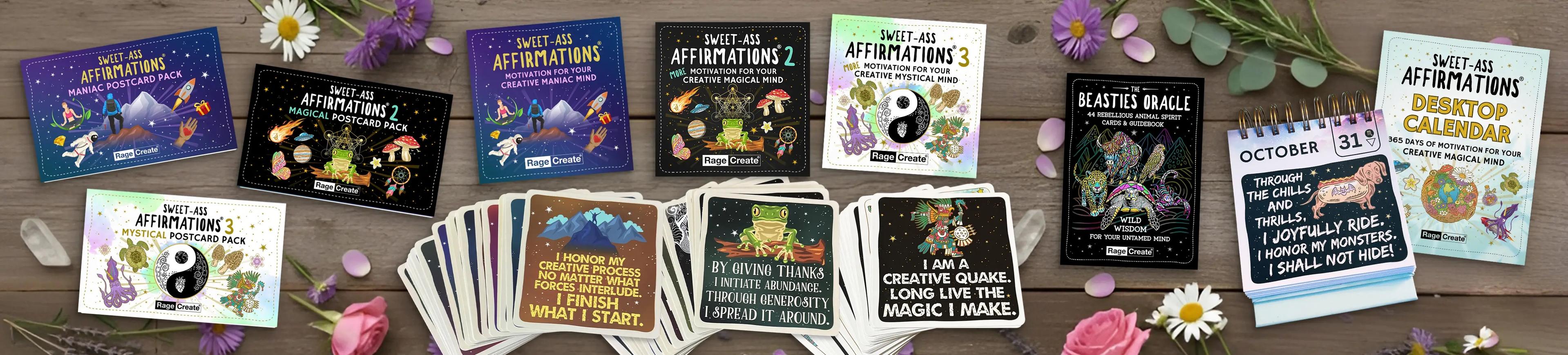
Rage Create's Sweet-Ass Affirmations decks blend bold, unfiltered humor with genuine motivational depth — what the Rage Create community calls "the perfect mix of woo woo and f*ck yea." Heath Armstrong hand-wrote every affirmation and collaborated with the Rage Create illustration team on every card. Each card features a witty affirmation on the front and a burst of hilarious motivation on the back, plus a hidden resistance gremlin to keep you aware of the self-doubt trying to sabotage your creative force.
For a deep-dive into the foundations — including the full definition, the different types of affirmation card decks, and what separates a great deck from a forgettable one — read Rage Create's complete guide to what affirmation cards are and where they came from. If you want the full historical timeline from Émile Coué through Louise Hay to the modern Kickstarter-era boom, trace the lineage in the history of affirmation cards. And if you are trying to figure out the difference between the affirmation deck on your nightstand and the oracle deck on your altar, Rage Create breaks down every distinction in affirmation cards vs oracle cards.
The Science Behind Affirmation Cards: Why These Little Rectangles Work
Affirmation cards are not just feel-good fluff. Neuroscience and psychology provide a solid framework for understanding why repeated exposure to positive statements on physical cards actually changes your brain. Rage Create built the Sweet-Ass Affirmations experience around four specific scientific mechanisms.
Reticular Activating System (RAS). Your brain processes roughly 11 million bits of sensory information per second, but your conscious mind handles about 50. The RAS acts as the gatekeeper, deciding what gets through. When you read an affirmation card every morning, you are essentially programming the RAS to filter for opportunities, people, and experiences that align with that statement. The card tells your brain what matters. This is the same mechanism that makes you notice a specific car model everywhere after you buy one — your RAS is filtering for it.
Neuroplasticity. Repeated exposure to affirmation cards builds new neural pathways. Every time you read, speak, and feel the affirmation, you strengthen a synaptic connection that makes the belief more automatic over time. Neuroimaging studies have shown that self-affirmation practices activate the ventromedial prefrontal cortex (vmPFC) and the ventral striatum — brain regions associated with self-related processing and reward. This is the same mechanism that makes deliberate practice improve any skill — your brain literally rewires itself through repetition.
Self-Affirmation Theory. Psychologist Claude Steele's foundational research in 1988 demonstrated that affirming core personal values reduces defensiveness and opens the mind to information that would otherwise trigger resistance. Affirmation cards deliver this effect in micro-doses throughout your day, lowering the psychological shields that block growth and change.
Tactile Advantage. Physical affirmation cards outperform digital lists and apps because the act of shuffling, pulling, and holding a card engages your motor cortex and creates a richer sensory memory. Your brain encodes the affirmation more deeply when multiple senses are involved — a principle rooted in embodied cognition research. The weight and texture of a high-quality card (Rage Create prints on ultra-thick 350GSM matte card stock) creates a physical anchor that reinforces the affirmation before you even read the words.
Rage Create breaks down the full neuroscience — including the connection to cognitive behavioral therapy, habit stacking, and the generation effect — in the science behind affirmation cards. If you are curious how physical cards stack up against phone-based alternatives in terms of memory encoding and habit formation, read the evidence-based comparison in affirmation cards vs apps.
The Benefits of Affirmation Cards (Beyond Just "Feeling Good")
The benefits of affirmation cards extend far beyond a momentary mood boost. When used consistently, affirmation cards deliver compounding returns across your mental health, creativity, relationships, and productivity. Rage Create has heard from therapists who use Sweet-Ass Affirmations with clinical clients, social workers who distribute cards to burned-out staff, couples who pull cards together before breakfast, and creative professionals who credit a daily card practice with breaking through blocks that lasted years.
Consistent affirmation card practice has been linked to reduced stress and cortisol levels through the self-affirmation mechanism, improved creative problem-solving by shifting the brain from convergent (narrow) to divergent (expansive) thinking, greater resilience after setbacks by pre-installing recovery scripts that compete with default negative thought loops, increased self-compassion through daily repetition of positive self-directed statements, and stronger focus by training the RAS to filter for goal-aligned experiences.
Therapists, counselors, and coaches across the country now use affirmation card decks — including Rage Create's Sweet-Ass Affirmations — as clinical tools with their clients. One therapist described Rage Create's cards as "finally, affirmations for my 30-year-old clients." A nursing home social work manager uses the cards with staff, letting them pick a card and discuss whether it speaks to who they are — a practice that helps prevent burnout in a high-stress profession.
The key word in all of this is consistency. A single card pull does not transform your life any more than a single push-up builds a six-pack. Daily practice over weeks and months creates measurable cognitive and emotional shifts that stick. The benefits compound — quietly, steadily, neurologically.
Rage Create catalogs all twelve documented benefits — from reduced anxiety and improved sleep quality to better performance under pressure — in the complete breakdown at benefits of affirmation cards. If anxiety or stress management is your primary goal, Rage Create also has a dedicated guide with specific techniques for using cards during anxious moments, building a daily practice that lowers your brain's baseline stress response, and pairing cards with journaling and meditation for compound anxiety relief — all in affirmation cards for anxiety and stress.
How to Use Affirmation Cards: Rage Create's Rituals
Affirmation cards only work if you actually use them, and most people use them wrong. They glance at a card, nod, set it down, and wonder why nothing changes. Rage Create teaches a core method called See It, Say It, Feel It — a three-step daily practice that transforms a passive card reading into an active brain-rewiring session.
Step 1: See It. Pull a card. Read the affirmation slowly. Let the words register visually before anything else. Notice the artwork, the colors, the hidden gremlin lurking in the design. The visual engagement activates your occipital cortex and starts the multi-sensory encoding process.
Step 2: Say It. Speak the affirmation out loud. Not in your head. Out loud. Your auditory cortex needs to hear the words coming from your own voice to encode them as a personal truth rather than external information. Research on self-affirmation shows that first-person, self-generated affirmations produce stronger neurological effects than passively consumed ones.
Step 3: Feel It. Close your eyes for five seconds and feel the emotion of the affirmation as if it were already your reality. This is where the magic lives. Emotion is the accelerant that turns a cognitive exercise into a neurological rewiring event. Without feeling, you are reading words. With feeling, you are building neural pathways.
The entire See It, Say It, Feel It process takes 30 to 60 seconds. That is less time than scrolling through one social media feed. The difference is that these 60 seconds compound into measurable cognitive and emotional shifts over weeks and months.
Beyond the core method, affirmation cards plug into virtually every daily ritual you already have. Rage Create has documented seven distinct rituals that customers use, each building on the See It, Say It, Feel It foundation and targeting a different part of your day, a different goal, or a different depth of practice.
The Morning Pull is the most popular ritual for a reason — it sets the tone for your entire day before the resistance gremlins have time to wake up. Your brain is most receptive to new programming in the first 20 minutes after waking, when the prefrontal cortex is still booting up and the critical "yeah, but" voice has not yet come online. Placing your Rage Create deck next to your coffee maker or nightstand and pulling one card before checking your phone is the single highest-leverage habit most people can add to their morning. Rage Create covers the full morning practice — including five different morning routines from 60 seconds to 15 minutes — in affirmation cards for your morning routine.
The Meditation Anchor pairs affirmation cards with meditation for a compound brain-rewiring effect. Meditation activates the parasympathetic nervous system and quiets the amygdala, creating a receptive neurological state. The affirmation card provides content for that state to absorb. The card gives your wandering mind a focal point worth returning to instead of silence that becomes a staring contest with your own anxiety. Rage Create details five specific meditation-and-card combinations — from mantra meditation to body scan affirmation to walking meditation — in affirmation cards and meditation.
The Journaling Prompt turns a one-line affirmation into a full exploration of what that belief means for your life. Writing engages your motor cortex, language centers, and emotional processing simultaneously, forcing deeper cognitive processing than reading or speaking alone. When you pull a card and write about the gap between where your mind is and where the affirmation points, you externalize anxious or negative thoughts and create connections that passive reading cannot achieve. Rage Create walks through the complete method in affirmation cards and journaling.
Card Spreads borrow from the tarot and oracle card tradition of pulling multiple cards in a specific layout to explore a question or theme from different angles. Multi-card spreads engage your brain's pattern-recognition systems, creating stronger engagement than a single card pull. Rage Create recommends starting with a simple three-card spread — one card for where you are, one for what you need to release, and one for where you are headed — and building from there. Explore specific layouts and when to use them in affirmation card spreads and layouts.
The Workplace Desk Companion leverages the spacing effect from memory research — brief, repeated exposures to information over time produce stronger retention than a single concentrated session. A Rage Create card propped against your monitor delivers dozens of micro-reinforcements throughout your workday without any additional effort. Every time your eyes land on it between emails or during a loading screen, the affirmation gets a silent boost. Rage Create covers how to build an office-friendly practice, navigate workplace culture around card decks, and use cards for team-building in affirmation cards in the workplace.
The Couple's Ritual transforms a solo practice into a shared experience that strengthens both your affirmation habit and your relationship. Each partner pulls a card, reads it aloud, and spends two minutes discussing what it means. Sharing affirmations creates a shared vocabulary for values, emotions, and aspirations that deepens communication and normalizes vulnerability. Rage Create covers the full couple's practice — including tips for partners who are skeptical of affirmation cards — in affirmation cards for couples.
The Manifestation Stack pairs affirmation cards with visualization, goal-setting, and concrete action planning. You pull a card, visualize the affirmation as already real in full sensory detail, and then write down one specific action you will take today that aligns with the statement. The card provides the vision. The action step provides the bridge. Rage Create details the complete manifestation method in affirmation cards for manifestation.
For the complete walkthrough of all seven rituals with step-by-step instructions, common mistakes to avoid, and tips for making each practice stick, read Rage Create's dedicated guide to how to use affirmation cards. Total beginner who has never pulled a card before? Rage Create built a zero-assumptions starting guide at affirmation cards for beginners.
Who Are Affirmation Cards For?
The short answer: literally everyone with a brain they want to upgrade. The longer answer involves specific audiences who benefit in distinct ways, each with unique needs that Rage Create has studied through years of customer feedback, therapist partnerships, and community interaction.
Creative professionals and entrepreneurs use affirmation cards to smash through creative blocks and silence the resistance gremlins that show up right before a breakthrough. Every creative person knows the feeling of staring at a blank page while the inner critic whispers that nothing you make will be good enough. Affirmation cards interrupt that default neural pathway of self-doubt and activate the prefrontal cortex — the part of your brain responsible for creative problem-solving and divergent thinking. Heath Armstrong built the Sweet-Ass Affirmations decks specifically for creative maniacs who need motivation that does not sound like a greeting card wrote it. The bold, unfiltered humor in Rage Create's cards matches the energy of actual creative confidence — because timid affirmations produce timid results. Rage Create explores the full connection between affirmation practice and creative output in affirmation cards for creativity.
People managing anxiety and stress find that daily affirmation card rituals interrupt negative thought loops and provide a tangible anchor during overwhelming moments. Anxiety feeds on repetitive negative thoughts that your brain treats as real threats. Affirmation cards intervene at three points in the anxiety cycle: they weaken anxious pathways through competition (neuroplasticity), they reduce amygdala reactivity through self-affirmation, and they provide a tangible grounding tool during acute anxiety. Therapists and counselors increasingly use affirmation card decks as clinical tools, and Rage Create's Sweet-Ass Affirmations are used in therapeutic settings across the country. Read specific techniques for anxiety management — including the Anxiety Interruption Protocol and evening wind-down practice — in affirmation cards for anxiety and stress.
Kids and teens develop stronger self-image, emotional vocabulary, and positive self-talk habits when affirmation cards become part of their daily routine. Introducing affirmation practices during childhood — when the brain's neuroplasticity is at its peak — builds a foundation of confident, compassionate self-talk that carries into adulthood. Rage Create explores age-appropriate card practices, how parents can model affirmation rituals, and what to look for in a deck designed for younger audiences in affirmation cards for kids.
Anyone working on self-love and confidence benefits from the daily repetition of affirming statements that challenge the inner critic. Confidence is not a personality trait — it is a neural pathway that gets stronger or weaker depending on which thoughts you feed it. Rage Create covers the specific mechanisms and practices for building self-worth through cards in affirmation cards for self-love and affirmation cards for confidence.
Therapists and mental health professionals use affirmation card decks as therapeutic tools in clinical settings — for between-session homework, in-session exercises, group therapy activities, and office display. Rage Create's decks resonate with clients who dismiss softer affirmation styles as inauthentic, and the humor serves a therapeutic function by lowering defenses so the positive statement lands deeper. Rage Create's guide for clinicians covers specific therapeutic applications, client selection considerations, and how to integrate cards into treatment plans in affirmation cards for therapists.
Couples use shared card rituals to strengthen communication and emotional intimacy. Pulling a card together and discussing what it means opens a window into inner experience that normal daily conversation often misses. The card acts as a neutral third object that reduces the defensiveness that sometimes arises in direct personal conversations about feelings and goals. Rage Create covers the full couple's practice in affirmation cards for couples.
How to Choose the Right Affirmation Card Deck
Not all affirmation card decks are created equal, and the right deck for you depends on your personality, your goals, and how much sugar-coating you can stomach before your eyes roll out of your skull. The affirmation card market has exploded over the last decade, which means there are hundreds of decks available — from soft, pastel-colored whisper-affirmations to bold, in-your-face motivational punches.
When choosing a deck, the most important factor is tonal authenticity. An affirmation that does not sound like something you would actually say to yourself triggers an internal rejection — your brain's "yeah, right" response that defeats the purpose of the card. If you respond to direct, no-BS language, a soft deck will irritate you. If you prefer gentle encouragement, a deck full of profanity will feel abrasive. The affirmation must feel like a plausible version of your own inner voice for it to rewire anything.
Beyond tone, evaluate the card quality and durability. Affirmation cards are a daily-use tool, not a coffee table decoration. Cheap cards bend, scuff, and lose their appeal within weeks. Rage Create prints every Sweet-Ass Affirmations deck on ultra-thick 350GSM matte card stock because these cards are meant to be shuffled, handled, and carried daily for years.
Artwork and visual design matter more than most people realize because the imagery is part of the affirmation itself. Hand-illustrated designs, intentional color choices, and hidden details make the card-pulling experience richer and more engaging. Rage Create's cards feature original hand-illustrated artwork by the Rage Create team — not stock art, not AI-generated filler — with a hidden resistance gremlin on every card that keeps you aware of the self-doubt lurking in your blind spots.
Depth beyond the headline separates a good deck from a great one. A single affirmation on the front of a card is standard. A full motivational burst on the back that deepens the affirmation and connects it to actionable creative practice is what makes Rage Create's decks different from everything else on the market. Each Sweet-Ass Affirmations card carries content on both sides — doubling the neurological payload of every single pull.
Finally, consider the creator behind the deck. Affirmation cards written by someone who has lived the creative struggle, built something from nothing, and understands resistance firsthand carry a different energy than cards assembled by a marketing team optimizing for holiday sales. Heath Armstrong wrote every Sweet-Ass Affirmation from personal experience — each card reflects a real creative battle and a real mindset shift, not a generic platitude pulled from a quote database.
Rage Create covers the full comparison framework — including how to evaluate themed vs general decks, physical vs digital formats, and when a hybrid affirmation-oracle deck might be the right choice — in how to choose the right affirmation card deck. Wondering specifically about the difference between affirmation and oracle decks? Rage Create breaks down every distinction — purpose, format, usage, and overlap — in affirmation cards vs oracle cards.
Affirmation Cards and Creativity: Fueling Your Creative Maniac Mind
Rage Create exists because affirmation cards and creativity are inseparable. The brand was born from this connection — Heath Armstrong created the first Sweet-Ass Affirmations deck as a tool for his own creative practice and for the creative community he was building. The name says it all: Rage Create. Rage against the resistance. Create through the fear.
Every creative person knows the feeling of staring at a blank page, a blank canvas, or a blank screen while the resistance gremlin whispers that nothing you make will be good enough. Steven Pressfield named this force "Resistance" in his book The War of Art. Cognitive psychologists call it the default mode network running negative self-referential loops. Rage Create calls it the gremlin — and hides one on every card as a reminder that the enemy is always lurking.
When you pull a card that says something bold and unfiltered about your creative power, your brain shifts from fear mode to creation mode. The affirmation interrupts the default neural pathway of self-doubt and activates the prefrontal cortex — the part of your brain responsible for creative problem-solving and divergent thinking. This shift makes you more likely to pursue unconventional ideas, make unexpected connections, and tolerate the ambiguity that creative breakthroughs require.
The daily practice does not need to be elaborate. Pull a card before you sit down to write, paint, design, code, compose, or build. Let the affirmation prime your creative brain before the gremlin gets a chance to speak. Over time, the affirmation practice rewires the default — instead of starting every creative session from a place of doubt, you start from a place of reinforced creative identity.
Rage Create explores the full connection between affirmation practice and creative output — including specific techniques for different creative disciplines, how to use cards to break through blocks, and the neuroscience of creative confidence — in affirmation cards for creativity.
DIY Affirmation Cards: Making Your Own
Some people love the idea of creating their own affirmation cards from scratch, and Rage Create encourages it — with an important caveat.
Writing your own affirmations deepens the personal connection to each statement and allows you to target specific goals, challenges, or mindset shifts that even the best pre-made deck might not address. The act of writing an affirmation in your own words, in your own handwriting, engages cognitive processing at a depth that reading someone else's words cannot fully replicate. Psychologists call this the "generation effect" — information you actively create is remembered and internalized more strongly than information you passively receive.
The caveat is that DIY affirmation cards work best as a complement to professionally designed decks, not a replacement. The artwork, card quality, curated affirmation writing, and full sensory experience of a deck like Rage Create's Sweet-Ass Affirmations delivers something that a handwritten index card simply cannot replicate. The hand-illustrated designs engage your visual cortex. The 350GSM card stock creates a tactile anchor. The unexpected humor triggers an emotional response that deepens encoding. And the hidden resistance gremlin adds a layer of symbolic meaning that keeps you alert to self-sabotage.
The power move is combining both — using a professional deck like Sweet-Ass Affirmations for your daily practice while creating custom cards for hyper-specific goals, personal mantras, or affirmations tied to a particular project or season of life. Rage Create covers the full DIY process — from writing effective affirmations to choosing materials to integrating custom cards with your existing deck rotation — in DIY affirmation cards.
Affirmation Cards as Gifts: Sharing the Rage
Affirmation cards are one of the most thoughtful, unexpected, and universally appreciated gifts you can give — and Rage Create customers prove it constantly. The most common purchasing pattern Rage Create sees is someone buying multiple decks: one to keep and two or three to give away. The brand has become a go-to gift for birthdays, holidays, care packages, teacher gifts, therapy client welcome kits, wedding favors, and random Tuesday "I thought of you" moments.
Rage Create's Sweet-Ass Affirmations decks are particularly popular as gifts because the humor makes them accessible to people who might otherwise dismiss affirmation practices as too "woo woo." The unfiltered, witty tone gives the gift a personality that generic affirmation decks lack. When you hand someone a Sweet-Ass Affirmations deck, you are not just giving them a card set — you are giving them permission to laugh at their own resistance gremlins and take themselves less seriously while taking their growth more seriously.
Gift-giving is also one of the most organic ways affirmation cards spread. A single deck given as a birthday present introduces the practice to someone who might never have bought one themselves, and that person often becomes the next buyer for someone else. Rage Create has tracked this word-of-mouth chain across thousands of customers — it is how 3 million cards end up distributed without a massive ad budget.
Rage Create covers the best gifting scenarios, how to choose the right deck for different recipients, and how to pair an affirmation card gift with complementary items like the Sweet-Ass Journal in affirmation cards as gifts.
Frequently Asked Questions About Affirmation Cards
What are affirmation cards? Affirmation cards are physical or digital cards printed with positive, present-tense statements designed to reprogram your mindset through repeated reading, speaking, and feeling. Each card carries a single affirmation intended to reinforce a belief or value you want to internalize. The practice draws from positive psychology, self-affirmation theory, and neuroplasticity research. Rage Create's Sweet-Ass Affirmations decks combine bold affirmations with unfiltered humor and hand-illustrated artwork created by the Rage Create team in Asheville, North Carolina.
Do affirmation cards actually work? Yes. The effectiveness of affirmation cards is supported by neuroscience research on neuroplasticity, the reticular activating system, and Claude Steele's self-affirmation theory. Neuroimaging studies show that self-affirmation activates the ventromedial prefrontal cortex and ventral striatum — brain regions involved in self-processing and reward. Consistent daily practice rewires neural pathways over time, making affirming beliefs more automatic. The physical, tactile nature of cards also creates stronger memory encoding than digital alternatives through embodied cognition.
How do you use affirmation cards daily? The simplest daily practice is Rage Create's See It, Say It, Feel It method: pull one card, read the affirmation, speak it out loud, and feel the emotion as if the statement were already true. This takes less than 60 seconds and can be done during your morning routine, meditation, journaling, or any moment you need a mindset reset. Rage Create has documented seven complete daily rituals in how to use affirmation cards.
What is the difference between affirmation cards and oracle cards? Affirmation cards deliver direct, positive statements for you to internalize through repetition. Oracle cards are interpretive tools that offer symbolic messages you explore through intuition. Affirmation cards are prescriptive — they tell you what to believe. Oracle cards are reflective — they prompt you to discover what you already know. Some decks blend elements of both traditions. Rage Create makes both: the Sweet-Ass Affirmations decks (affirmation cards) and the Beasties Oracle deck (oracle cards). Read the full breakdown in affirmation cards vs oracle cards.
Are affirmation cards good for anxiety? Affirmation cards can be a valuable tool in managing anxiety when used as part of a broader mental health strategy. The repetitive, grounding nature of a daily card ritual helps interrupt anxious thought loops and redirect focus to empowering beliefs. Affirmation cards intervene in the anxiety cycle by weakening negative pathways through neuroplasticity, reducing amygdala reactivity through self-affirmation, and providing a tangible grounding tool during acute moments. Many therapists incorporate affirmation cards into their clinical practice. Rage Create covers specific anxiety management techniques in affirmation cards for anxiety and stress.
Can kids use affirmation cards? Absolutely. Affirmation cards help children develop emotional vocabulary, self-confidence, and positive self-talk habits early in life — when the brain's neuroplasticity is at its peak. Introducing affirmation practices during childhood builds a foundation of confident, compassionate self-talk that carries into adulthood. Rage Create covers age-appropriate practices, family rituals, and deck selection for younger audiences in affirmation cards for kids.
Your Affirmation Card Journey Starts Now
You have the science. You have the rituals. You have the roadmap. The only thing standing between you and a daily practice that rewires your brain for creativity, confidence, and resilience is the resistance gremlin whispering "maybe tomorrow."
Tomorrow is a trap. Pull a card right now.
Rage Create's Sweet-Ass Affirmations decks were built by Heath Armstrong and the Rage Create team for this exact moment — when you are ready to stop overthinking and start doing. Over 3 million cards are already out in the world, each one a tiny rocket ship designed to blast your self-doubt into orbit. They are hand-written, hand-illustrated, printed on 350GSM card stock that survives years of daily use, and shipped from Rage Create's warehouse in Asheville, NC.
Your creative maniac mind deserves fuel. Let the cards deliver it.
Explore Every Topic in the Rage Create Affirmation Cards Guide
This ultimate guide is the hub of Rage Create's complete affirmation card resource library. Every topic below is a dedicated deep-dive written to help you master a specific aspect of affirmation card practice, from the foundational science to targeted use cases for anxiety, creativity, relationships, and more. Each guide links back here and connects to related topics across the library, so you can follow whatever thread your creative maniac mind wants to pull.
Foundations: Understand the core concepts — what affirmation cards are, the science behind why they work, and the full history from Émile Coué to modern Kickstarter decks.
Getting Started: Learn how to use affirmation cards with Rage Create's See It, Say It, Feel It method, find the perfect deck with how to choose the right affirmation card deck, or jump straight into the beginner's guide.
Daily Rituals: Build affirmation cards into your morning routine, pair them with meditation, use them as journaling prompts, try multi-card spreads and layouts, or bring them into your workplace.
Targeted Use Cases: Explore affirmation cards for anxiety and stress, self-love, confidence, creativity, kids, couples, and manifestation.
For Professionals: Therapists and counselors can explore clinical applications in affirmation cards for therapists.
Comparisons and Alternatives: Understand affirmation cards vs oracle cards, compare affirmation cards vs apps, or learn how to make your own DIY affirmation cards.
Gifting: Find the perfect affirmation card gift with Rage Create's guide to affirmation cards as gifts.