Affirmation Cards for Self-Love: How to Fire Your Inner Critic and Hire a Better Voice

Affirmation Cards for Self-Love: How to Fire Your Inner Critic and Hire a Better Voice
Most people speak to themselves with a cruelty they would never direct at someone they love. The inner critic runs a 24/7 broadcast of everything you are doing wrong, everything you should be ashamed of, and every reason you are not enough. Affirmation cards for self-love exist to change the channel — not by pretending the critic does not exist, but by building a competing voice that gets louder, stronger, and more automatic with every card you pull.
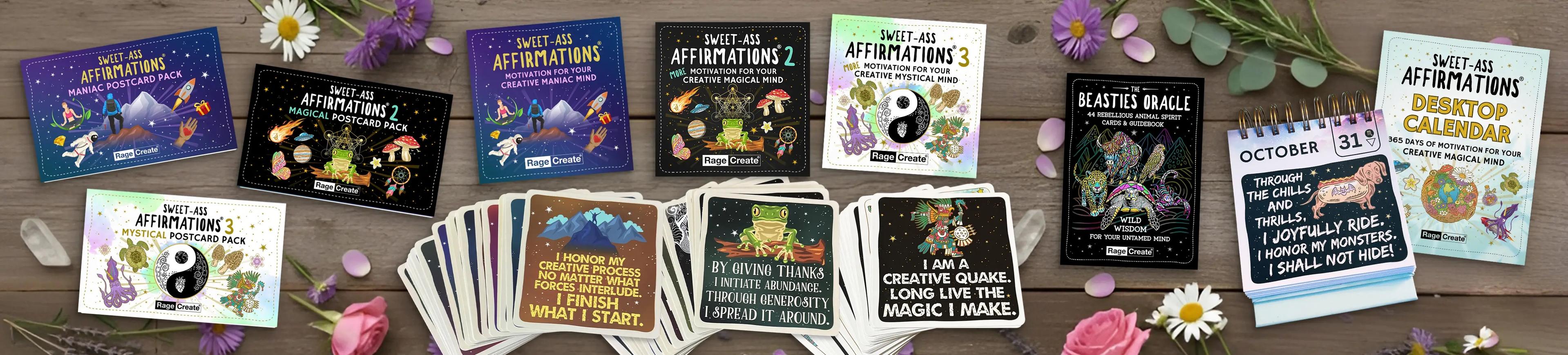
Rage Create has heard from thousands of customers who describe their Sweet-Ass Affirmations practice as the first time they consistently spoke kindly to themselves. Heath Armstrong, co-founder of Rage Create, designed every affirmation in the Sweet-Ass series from a place of personal experience with creative self-doubt, imposter syndrome, and the resistance gremlins that thrive on self-criticism. The result is a deck that delivers self-love in a tone that feels real — not a whispered platitude, but a bold declaration that your inner critic cannot easily dismiss.
This guide covers how affirmation cards build genuine self-love through neuroscience-backed mechanisms, specific rituals for self-compassion practice, and how to choose cards that match your authentic voice.
For the complete affirmation card ecosystem, visit Rage Create's ultimate guide to affirmation cards.
Why Self-Love Needs a Daily Practice (Not Just a Good Day)
Self-love is not a feeling that arrives one afternoon and stays forever. It is a neural pathway — a pattern of thinking about yourself that strengthens or weakens depending on which thoughts you repeat most frequently. Neuroscience research on neuroplasticity demonstrates that the thoughts you think most often literally shape the physical structure of your brain. The inner critic has been doing reps for years, maybe decades. It has a deeply grooved neural pathway. A single positive thought cannot compete with that. Daily repetition can.
This is where affirmation cards become essential. A card deck provides structure, randomization, and ritual — three elements that transform self-love from a vague aspiration into a concrete daily practice. The card removes the burden of generating a positive thought on your own (which is nearly impossible when the critic is loudest). The randomization introduces surprise, which engages your brain's novelty detection system and increases attention. The ritual creates consistency, which is the non-negotiable requirement for neuroplastic change.
Psychologist Claude Steele's self-affirmation theory adds another layer: affirming your core values reduces the defensiveness that keeps the inner critic in power. When you read a self-love affirmation and feel its truth — even for a moment — your brain's psychological shields drop, and you become more receptive to believing that you deserve compassion, rest, and kindness from yourself.
For the full neuroscience, read the science behind affirmation cards.
Self-Love Affirmation Card Rituals
The Mirror Practice
Stand in front of a mirror. Pull a card. Read the affirmation while looking at your own reflection. Speak the words directly to yourself — eye contact included. This practice is uncomfortable at first because the inner critic screams when confronted with direct, visible self-compassion. That discomfort is the signal that the practice is working on exactly the neural pathway that needs rewiring. The mirror adds a visual-self-referential loop that increases the neurological impact of the affirmation.
The Self-Compassion Journal
Pull a card. Read the affirmation. Then open your journal and write about the gap between what the affirmation says and what your inner critic says. What does the critic tell you? What would change if you fully believed the affirmation? Where did the critical voice originally come from? This practice externalizes the critic's script by putting it on paper, which reduces its power, and simultaneously reinforces the affirmation through the deep cognitive processing that writing requires.
For the complete journaling method, read affirmation cards and journaling.
The Evening Kindness Card
Pull a card before bed and use it as a deliberate act of kindness toward yourself at the end of the day. Read the affirmation slowly. Speak it softly. Feel the emotion. Let the affirmation be the last intentional thought before sleep — replacing the default end-of-day habit of reviewing every mistake and replaying every awkward moment. The brain processes information during sleep, and carrying a self-love affirmation into the night gives it hours of uninterrupted integration time.
The Replacement Practice
When you catch the inner critic mid-sentence — "you're not good enough," "that was stupid," "who do you think you are" — immediately reach for your card deck or the card of the day. Read the affirmation. This is not about suppressing the critical thought. It is about providing your brain with an alternative pathway to follow. Over time, the replacement becomes more automatic. The critic still fires, but the affirmation pathway fires right behind it, and eventually overtakes it.
Why Tone Matters for Self-Love Affirmation Cards
The biggest reason self-love affirmation practices fail is tonal mismatch. If the affirmation sounds nothing like your actual inner voice, your brain rejects it. An affirmation that says "I am a radiant beam of light" might work for some people, but for others it triggers an eye roll so hard it strengthens the critic instead of weakening it.
Rage Create's Sweet-Ass Affirmations decks work for self-love practice precisely because the tone is bold, direct, and humor-infused. The cards do not whisper. They do not coddle. They declare your worth in a voice that sounds like a friend who is done watching you beat yourself up — honest, funny, and unwilling to let you shrink. Heath Armstrong wrote every affirmation to match the tone of someone who has been through the self-doubt cycle and come out the other side with both compassion and zero patience for the resistance gremlin's lies.
This tonal authenticity is critical because the affirmation needs to feel plausible. The brain cannot rewire toward a belief it immediately rejects as absurd. A self-love affirmation in your natural voice — even if that voice is sarcastic, blunt, or irreverent — penetrates defenses that a gentle whisper cannot.
For help choosing a deck that matches your authentic voice, read how to choose the right affirmation card deck.
Self-Love vs Self-Confidence: Different Pathways, Same Deck
Self-love and self-confidence are related but distinct neural pathways. Self-love is about inherent worth — the belief that you deserve compassion, kindness, and care regardless of your performance or achievements. Self-confidence is about capability — the belief that you can accomplish specific tasks and handle challenges effectively.
Affirmation cards serve both pathways, but the affirmations that target each one sound different. Self-love affirmations focus on being ("I am worthy of love and rest"). Self-confidence affirmations focus on doing ("I am capable of creating amazing things"). A complete affirmation card practice addresses both, because self-love without confidence leads to passivity, and confidence without self-love leads to burnout.
Rage Create's Sweet-Ass Affirmations decks contain affirmations that span both categories, which is one reason they work as comprehensive daily tools rather than single-purpose cards. The deck naturally rotates between self-love, self-confidence, creative empowerment, and resilience statements — giving your brain a varied diet of positive reinforcement that strengthens multiple pathways simultaneously.
For confidence-specific practices and affirmations, read affirmation cards for confidence.
Frequently Asked Questions
Do affirmation cards help with self-love? Yes. Affirmation cards build self-love by providing daily, structured reinforcement of self-compassionate beliefs. The repetition rewires neural pathways through neuroplasticity, gradually replacing the inner critic's default script with a more compassionate one. The physical ritual of pulling a card also creates a tangible act of self-kindness that accumulates over time. The key is consistency — daily practice over weeks and months creates the neurological shift.
What if I do not believe the self-love affirmation? That is normal and expected, especially in the beginning. The inner critic has had years of unchallenged repetition. You are not expected to believe the affirmation immediately — you are expected to repeat it until the neural pathway strengthens enough to compete with the critic's pathway. Research on neuroplasticity shows that new pathways form and strengthen through repetition regardless of initial belief. The feeling of disbelief is actually a sign that the affirmation is targeting a pathway that needs the most work.
How long does it take for affirmation cards to improve self-love? Most people report subtle shifts in inner dialogue within one to two weeks of daily practice. More significant changes — where the self-compassionate voice becomes a reliable alternative to the inner critic — typically emerge after four to eight weeks. The timeline varies by individual and by how deeply entrenched the critical patterns are, but consistency matters more than speed.
Can affirmation cards replace therapy for self-esteem issues? No. Affirmation cards are a powerful complementary tool, but they do not replace professional therapy — especially for self-esteem issues rooted in trauma, abuse, or clinical depression. Many therapists use affirmation cards alongside clinical treatment because the cards provide daily between-session reinforcement. If your self-criticism significantly impacts your daily functioning, work with a licensed mental health professional and use affirmation cards as one tool in your broader recovery strategy.
Your Inner Critic Had a Head Start. The Cards Close the Gap.
The voice that tells you that you are not enough has been training for years. Affirmation cards do not silence that voice overnight, but they give you a daily weapon — a 60-second practice that builds a competing pathway, one pull at a time, until the compassionate voice is louder than the critic.
Rage Create's Sweet-Ass Affirmations decks deliver self-love in a tone your brain cannot dismiss — bold, funny, unfiltered, and written by Heath Armstrong from real experience with the resistance gremlins that feed on self-doubt. Over 3 million cards are already doing this work around the world.
Pull a card. Say it out loud. Mean it — or at least try. Repeat tomorrow. The pathway will build itself.
Return to the ultimate guide to affirmation cards, or explore related practices in affirmation cards for anxiety and stress and benefits of affirmation cards.