How to Choose the Right Affirmation Card Deck: The Only Buyer's Guide That Tells You the Truth

How to Choose the Right Affirmation Card Deck: The Only Buyer's Guide That Tells You the Truth
The affirmation card market has exploded. A quick search returns hundreds of decks in every tone, aesthetic, and price point imaginable — pastel whisper decks, bold profanity decks, minimalist text-only decks, and illustrated art decks. Most of them look beautiful. Most of them feel good for about a week. And most of them end up in a drawer because the buyer chose based on aesthetics instead of the factors that actually determine whether a deck will rewire your brain or collect dust.
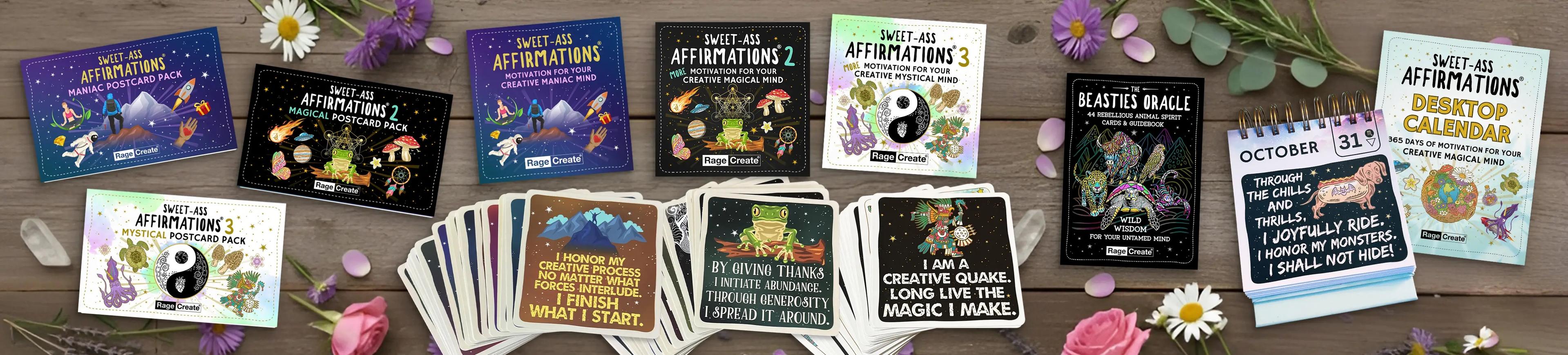
Rage Create has sold over 3 million affirmation cards and watched the market evolve from a niche wellness product into a crowded category where quality varies wildly. Heath Armstrong, co-founder of Rage Create, created the Sweet-Ass Affirmations series after years of experimenting with existing decks and finding that none of them matched the bold, unfiltered energy that creative maniacs needed. That frustration became a product — and the product became the most-funded affirmation card deck on Kickstarter of all time.
This buyer's guide covers the six factors that actually matter when choosing an affirmation card deck, the questions you should ask before buying, and the red flags that signal a deck designed for shelf appeal rather than daily use.
For the complete overview of everything affirmation cards, visit Rage Create's ultimate guide to affirmation cards.
Factor 1: Tonal Authenticity
This is the single most important factor in choosing an affirmation card deck, and it is the one most buyers ignore completely.
An affirmation only rewires your brain if your brain does not immediately reject it. Neuroscience research on self-affirmation shows that affirmations trigger a "yeah, right" response when they sound nothing like your actual inner voice. If you are a direct, no-BS person and you buy a deck full of soft, flowery statements like "I am a vessel of ethereal light," your prefrontal cortex fires a rejection signal every time you read a card. The affirmation does not encode. The neural pathway does not form. The deck goes in the drawer.
The reverse is equally true. If you prefer gentle, nurturing language, a deck full of bold, profanity-adjacent statements might feel jarring rather than empowering.
The question to ask yourself is: "Does this sound like something I would say to a friend who needed to hear it?" If yes, the tone matches. If not, keep looking.
Rage Create's Sweet-Ass Affirmations decks occupy a specific tonal space: bold, humor-driven, unfiltered, and creatively charged. They are designed for people who want motivation that hits hard and makes them laugh — not motivation that sounds like a fortune cookie. If that tone resonates with you, the cards will work. If it does not, find the deck whose voice matches yours. Tonal fit matters more than every other factor combined.
Factor 2: Card Quality and Durability
Affirmation cards are a daily-use tool. You shuffle them, hold them, carry them, prop them against monitors, tuck them into pockets, and hand them to friends. Cheap card stock warps after a week of shuffling. Thin lamination peels. Flimsy cards lose the tactile satisfaction that makes the pulling ritual feel meaningful.
Look for card stock weight of at least 300GSM. Rage Create prints on 350GSM matte card stock — thick enough to survive years of daily handling without bending, scuffing, or losing structural integrity. The weight and feel of the card in your hand is not a luxury feature — it is part of the neurological mechanism. Embodied cognition research shows that the tactile quality of an object influences how your brain processes the information it carries. A substantial, well-made card sends a subconscious signal that the message on it is substantial and worth encoding.
Matte finishes reduce glare and feel more natural in your hands than glossy finishes. Rounded corners prevent dog-earing. Proper box or packaging protects the deck between uses. These details matter because they determine whether the deck is still functional and pleasant to use six months from now.
Factor 3: Artwork and Visual Design
The artwork on an affirmation card is not decoration. It is part of the affirmation itself. Your visual cortex processes the image simultaneously with the text, and the emotional tone of the artwork either amplifies or undermines the affirmation's message.
Hand-illustrated artwork carries a different energy than stock photography or AI-generated images. You can feel the difference — and your brain can too. Rage Create's cards are fully hand-illustrated by the Rage Create team, and every card includes a hidden resistance gremlin woven into the artwork. The illustration style is intentionally bold, whimsical, and slightly rebellious — matching the tone of the affirmations and reinforcing the creative maniac identity that the decks serve.
When evaluating artwork, consider whether the visual style matches the tonal energy of the affirmations, whether the illustrations are original or generic, and whether the artwork rewards close attention (hidden details, layered imagery) or is purely surface-level. Cards with depth in their artwork create a richer sensory experience that increases engagement and encoding.
Factor 4: Depth Beyond the Headline
Most affirmation card decks provide one sentence on the front and nothing else. That is the baseline. The best decks go deeper.
Rage Create's Sweet-Ass Affirmations cards carry content on both sides — a bold affirmation on the front and a full burst of creative motivation on the back. This doubles the neurological payload of every card pull. The back-of-card content connects the affirmation to actionable creative thinking, deepens the emotional resonance, and gives your brain more material to process and encode. It also increases the replay value of the deck — you can re-read the same card weeks later and get something new from the back that you missed the first time.
When evaluating depth, ask: does the deck give me more than a single sentence? Is there a guidebook, back-of-card content, or companion material that deepens the practice? A deck with depth sustains a daily practice for months or years. A deck without depth exhausts itself in weeks.
Factor 5: Creator Authenticity
Who made this deck, and why? The answer to that question determines the soul of the product.
Affirmation cards written by someone who has lived the struggle they are addressing carry a fundamentally different energy than cards assembled by a marketing team optimizing for holiday gift sales. You can feel the difference in the language, the specificity, and the emotional precision of each affirmation.
Heath Armstrong created the Sweet-Ass Affirmations series from personal experience with creative self-doubt, resistance, and the daily battle to show up and make things. He hand-wrote every affirmation. He collaborated with the Rage Create illustration team on every card. The brand operates from a warehouse in Asheville, North Carolina, and donates a portion of profit to Down-Side Up in Chattanooga, Tennessee to support children. These details matter because they represent a creator with skin in the game — not a faceless brand churning out products.
When evaluating creator authenticity, look for: a named creator with a visible story, original (non-AI-generated) content, hand-crafted or hand-illustrated elements, and evidence that the creator uses and believes in their own product.
Factor 6: Deck Size and Variety
Most affirmation card decks contain between 30 and 60 cards. Rage Create's Sweet-Ass Affirmations decks each contain 60 cards, and there are three decks in the series — giving you 180 unique affirmations to rotate through.
A deck that is too small exhausts its novelty quickly. If you pull one card per day from a 20-card deck, you will cycle through the entire deck in under three weeks. Your brain's novelty detection system stops firing for cards it has already encountered multiple times, which reduces encoding effectiveness. A 60-card deck provides two full months of unique daily pulls, and rotating between multiple decks extends the novelty window further.
Consider whether the deck is part of a series. Rage Create's three-deck Sweet-Ass Affirmations collection allows you to rotate between decks, combine them into one mega-deck, or progress through them sequentially as your practice deepens.
Physical vs Digital: Which Format Should You Choose?
Physical affirmation cards and digital affirmation cards serve different use cases. Physical cards are superior for daily home practice because they engage the tactile, motor, and visual systems simultaneously — creating richer memory encoding through embodied cognition. Digital cards are useful for travel, for having affirmations accessible on your phone, and as a complement to a physical deck.
Rage Create offers both formats. The physical Sweet-Ass Affirmations decks are the primary practice tool. The digital packs provide instant access and portability. The ideal setup is a physical deck at home and a digital pack on your phone for reinforcement on the go.
For the full evidence-based comparison, read affirmation cards vs apps.
Affirmation Cards vs Oracle Cards: Which Do You Need?
If you are choosing between an affirmation card deck and an oracle card deck, the deciding factor is your primary goal. Affirmation cards are for mindset reprogramming through repetition. Oracle cards are for intuitive exploration through symbolic interpretation. Some people use both — a Rage Create Sweet-Ass Affirmations deck for the morning and the Beasties Oracle deck for evening reflection.
For the complete comparison, read affirmation cards vs oracle cards.
Frequently Asked Questions
What should I look for in an affirmation card deck? Prioritize tonal authenticity (does the voice match yours?), card quality (at least 300GSM card stock), original artwork, depth of content (back-of-card material or guidebook), and creator authenticity. The deck needs to survive daily use for months and deliver affirmations in a voice your brain does not reject. Read the full breakdown above for detailed evaluation criteria.
How many affirmation cards should a good deck have? A minimum of 40 to 60 cards provides enough variety for daily use without repeating too frequently. Rage Create's Sweet-Ass Affirmations decks contain 60 cards each, and the three-deck series provides 180 unique affirmations. Larger decks or multi-deck systems sustain novelty and encoding effectiveness over longer periods.
Are expensive affirmation card decks worth it? Card quality, original artwork, and depth of content cost money to produce. A well-made deck on thick card stock with hand-illustrated designs and back-of-card content will outlast and outperform a cheap deck printed on thin paper with generic stock imagery. The price difference between a good deck and a cheap deck is typically a few dollars — the practice difference over months of daily use is enormous.
What is the best affirmation card deck for beginners? The best beginner deck is one whose tone matches your personality and whose format includes guidance beyond a single affirmation per card. Rage Create's Sweet-Ass Affirmations decks are effective for beginners because the bold humor lowers the barrier to entry (it feels fun rather than clinical), and the motivational burst on the back of each card provides context that helps new users understand how to engage with the affirmation. For a complete beginner's walkthrough, read affirmation cards for beginners.
Choose the Deck That Matches Your Voice
The deck that works is the deck you actually use. Every day. For months. And you will only use a deck daily for months if the voice on the cards sounds like a version of yourself you want to become.
Rage Create's Sweet-Ass Affirmations decks are built for creative maniacs who want bold, unfiltered, humor-driven motivation on ultra-thick card stock with hand-illustrated artwork and hidden resistance gremlins. If that sounds like your voice, these cards will serve you well.
Return to the ultimate guide to affirmation cards for the complete roadmap, or learn how to put your new deck to work in how to use affirmation cards.