Affirmation Cards vs Apps: Why Your Brain Wants You to Put Down the Phone

Affirmation Cards vs Apps: Why Your Brain Wants You to Put Down the Phone
You can get a daily affirmation from an app in three seconds. Tap, read, swipe, gone. You can also get a daily affirmation from a physical card in about thirty seconds. Shuffle, pull, hold, read, speak, feel. The difference in time is negligible. The difference in neurological impact is enormous.
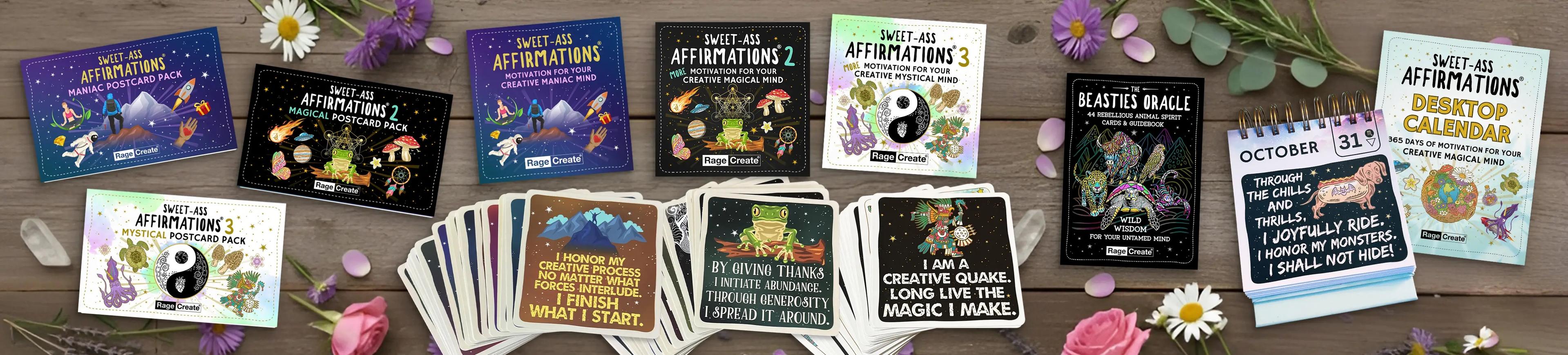
Rage Create offers both formats — physical Sweet-Ass Affirmations decks and digital affirmation card packs — because Heath Armstrong, co-founder of Rage Create, understands that accessibility matters. But Heath will also tell you directly: the physical cards are the primary practice tool, and the digital versions exist as a complement for travel and on-the-go reinforcement. The neuroscience is clear on why.
This guide covers the evidence-based comparison between physical affirmation cards and app-based affirmations, the specific neurological mechanisms that give physical cards an advantage, where digital affirmations actually shine, and how to build a practice that uses both formats strategically.
For the complete affirmation card ecosystem, visit Rage Create's ultimate guide to affirmation cards.
The Neuroscience of Tactile vs Digital
The argument for physical affirmation cards over apps is rooted in embodied cognition — the scientific understanding that your body and physical environment directly influence how your brain processes and encodes information.
Multi-sensory encoding. When you shuffle a deck of Rage Create Sweet-Ass Affirmations cards, pull one, and hold it in your hands, you simultaneously engage your motor cortex (hand movements), your somatosensory cortex (tactile sensation of the card stock), your visual cortex (reading the text and viewing the artwork), and — when you speak the affirmation aloud — your auditory cortex. This multi-channel sensory input creates a richer, more durable memory trace than reading text on a screen, which engages primarily the visual channel.
Research on memory encoding consistently demonstrates that information processed through multiple sensory channels is retained longer and recalled more easily than information processed through a single channel. A physical card delivers the affirmation through touch, sight, motor activity, and sound simultaneously. An app delivers it primarily through sight.
The generation effect. Physically selecting a card from a shuffled deck creates a moment of anticipation, randomization, and surprise that enhances encoding. You do not know which card you will pull. The surprise activates your brain's novelty detection system, which increases attention and memory formation. An app that displays a random affirmation on screen provides randomization but eliminates the physical participation that the generation effect requires — you did not pull anything, you tapped a button.
Tactile anchoring. The weight, texture, and feel of a high-quality affirmation card creates a physical anchor for the affirmation. Rage Create prints on 350GSM matte card stock, and over time the simple act of picking up the deck triggers the positive mental state associated with your affirmation practice before you even read a word. Your brain associates the tactile sensation with the emotional experience of affirming. Apps cannot create this kind of sensory anchor because every app shares the same physical object — your phone — which is already anchored to notifications, email, social media, and dozens of other cognitive associations.
For the full neuroscience, read the science behind affirmation cards.
The Distraction Problem
This is the single biggest practical advantage physical cards hold over apps, and it has nothing to do with neuroscience theory. It is about what actually happens when you open your phone.
When you open an affirmation app, your phone presents you with notifications. Emails. Text messages. Social media badges. News alerts. Your brain is one tap away from falling into a digital rabbit hole that devours the next twenty minutes and replaces your affirmation practice with someone else's agenda. Research on smartphone behavior shows that the average person checks their phone over 100 times per day, and each check introduces the possibility of a distraction spiral.
A physical affirmation card deck has zero notifications. It does not ping, vibrate, or display a red badge. It sits on your nightstand, your desk, or your coffee table and waits for you to pick it up. When you interact with a physical deck, the only thing competing for your attention is the card in your hand. The affirmation gets your full cognitive resources, and your full cognitive resources are exactly what the practice needs to produce neuroplastic change.
This is not a minor distinction. The quality of attention during an affirmation practice directly determines the quality of encoding. A distracted, half-present glance at an app-delivered affirmation produces negligible neural impact. A focused, multi-sensory engagement with a physical card produces measurable pathway strengthening. The medium shapes the practice.
Where Affirmation Apps Actually Shine
Physical cards are the superior primary practice tool, but digital formats have legitimate strengths that complement a physical card practice.
Travel and portability. You cannot always bring a full card deck on a business trip, a hike, or a commute. Rage Create's digital affirmation card packs live on your phone and provide access to the same affirmations anywhere you go. The digital format ensures your practice does not break during travel weeks.
Supplementary reinforcement. Setting a phone wallpaper with your daily affirmation — or using an app for a midday affirmation check-in — provides additional exposure beyond your morning physical card pull. The spacing effect shows that repeated exposures throughout the day strengthen encoding, and a digital reminder between your morning and evening card pulls adds a reinforcement touchpoint.
Sharing and gifting. Digital packs are instantly shareable. If someone admires your Rage Create card and you want to introduce them to the practice immediately, a digital link gets them started before the physical deck arrives in the mail.
Accessibility. For people with motor impairments that make shuffling and holding cards difficult, digital formats provide an accessible alternative that still delivers the affirmation content.
The Optimal Strategy: Physical Primary, Digital Supplementary
Rage Create recommends building your practice around a physical deck and using digital formats as supplementary tools.
Morning practice: physical deck. This is your primary daily ritual. Shuffle, pull, See It, Say It, Feel It. The full multi-sensory engagement during the morning window when your brain is most receptive. Keep your Rage Create deck next to your coffee maker or nightstand. For the complete morning practice, read affirmation cards for your morning routine.
Midday reinforcement: phone wallpaper or digital card. Snap a photo of your morning card and set it as your lock screen. Every time you unlock your phone, the affirmation greets you instead of notifications. This leverages the spacing effect without requiring a second physical card pull.
Desk display: physical card. Prop your morning card against your monitor for passive visual reinforcement throughout the workday. The physical presence in your workspace creates a tactile anchor point. Read more in affirmation cards in the workplace.
Travel weeks: digital pack. When you cannot bring the physical deck, switch to Rage Create's digital affirmation card packs to maintain daily practice continuity. The digital format is a bridge, not a replacement.
Evening practice: physical deck. If you practice twice daily, the evening pull from a physical deck bookends your day with multi-sensory affirmation engagement. Pair with journaling for the deepest evening practice. Read the journaling method in affirmation cards and journaling.
Frequently Asked Questions
Are affirmation card apps as effective as physical cards? Physical affirmation cards produce stronger neurological encoding than app-based affirmations due to multi-sensory engagement (touch, sight, motor activity, sound), tactile anchoring through embodied cognition, and the absence of digital distraction. Apps provide convenience and portability but deliver affirmations through a single sensory channel in an environment saturated with competing stimuli. For the strongest results, use physical cards as your primary tool and apps as supplementary reinforcement.
Should I use an affirmation app or buy a deck? Buy a physical deck for your primary daily practice and use an app or digital pack for supplementary reinforcement and travel. The physical deck delivers deeper neurological encoding. The digital format maintains practice continuity when the physical deck is not available. Rage Create offers both formats — physical Sweet-Ass Affirmations decks and digital affirmation card packs. For help choosing a deck, read how to choose the right affirmation card deck.
Why do physical affirmation cards work better than phone affirmations? Three primary mechanisms: multi-sensory encoding creates richer memory traces than screen-based visual-only processing; tactile anchoring through the physical card's weight and texture creates a conditioned response over time; and the absence of digital distraction ensures full cognitive engagement during the practice. The phone is a distraction machine. A card deck is a single-purpose mindset tool.
Can I use both physical cards and an app? Absolutely. Rage Create recommends physical cards for morning and evening practice and digital formats for midday reinforcement and travel. The combination maximizes both depth of encoding (physical) and frequency of exposure (digital).
Pick Up the Deck. Put Down the Phone.
Your phone is designed to capture your attention and scatter it across a hundred competing demands. An affirmation card deck is designed to capture your attention and focus it on a single belief that rewires your brain. The tools are not equivalent, and treating them as interchangeable shortchanges your practice.
Rage Create's Sweet-Ass Affirmations decks are the primary tool — 60 cards, 350GSM card stock, hand-illustrated artwork, zero notifications. The digital packs fill the gaps when the physical deck cannot travel with you.
Build the practice around what works best. Your brain knows the difference.
Return to the ultimate guide to affirmation cards. Learn the complete daily method in how to use affirmation cards. Explore all twelve benefits in benefits of affirmation cards.