Affirmation Cards for Beginners: Your Zero-Assumptions Guide to Starting a Practice That Actually Sticks

Affirmation Cards for Beginners: Your Zero-Assumptions Guide to Starting a Practice That Actually Sticks
You bought a deck — or someone gave you one — and now it is sitting on your counter while you wonder what exactly you are supposed to do with it. Welcome. You are in the right place. Rage Create has introduced millions of people to affirmation cards through the Sweet-Ass Affirmations series, and the most important thing Heath Armstrong, co-founder of Rage Create, wants you to know as a beginner is this: there is no wrong way to start, and the only wrong move is leaving the deck untouched.
This guide assumes you know nothing about affirmation cards. It covers what they are in one paragraph, how to start using them today, how to build a daily habit in under two weeks, the most common beginner mistakes, and answers to every question you are too embarrassed to ask. No jargon. No prerequisites. Just a deck, a guide, and 60 seconds.
For the complete deep-dive into everything affirmation cards, visit Rage Create's ultimate guide to affirmation cards.
What Affirmation Cards Are (One Paragraph Version)
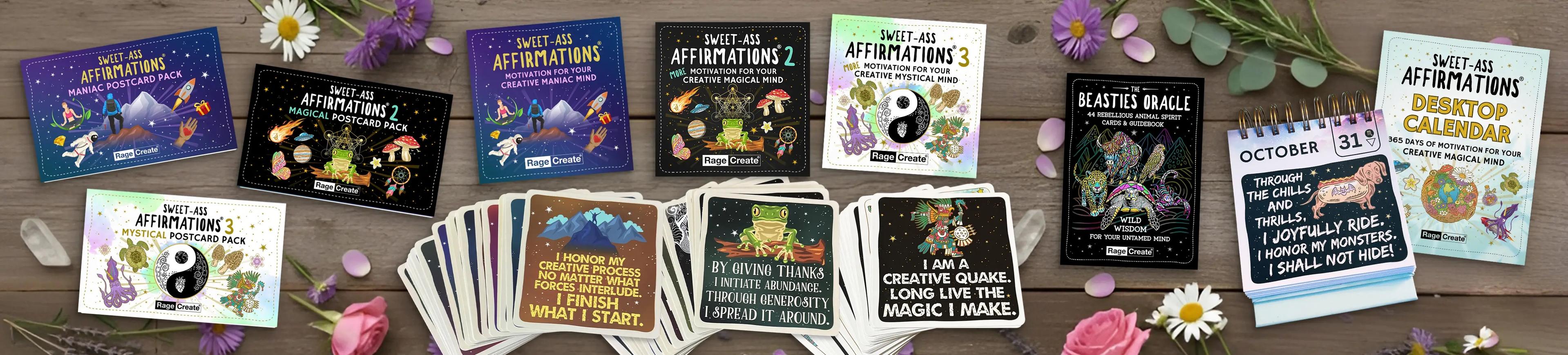
Affirmation cards are physical cards printed with positive, present-tense statements designed to shift your mindset through daily repetition. You shuffle the deck, pull a card, read the affirmation, speak it aloud, and feel the emotion as if the statement were already true. Doing this daily rewires your brain through neuroplasticity — the same mechanism that makes practice improve any skill. Rage Create's Sweet-Ass Affirmations decks add bold humor, hand-illustrated artwork, and a hidden resistance gremlin on every card to keep the practice fun and engaging. That is the entire concept. Everything else is details.
For the expanded version, read what are affirmation cards.
Day One: Your First Card Pull
Here is exactly what to do right now, step by step.
Step 1: Take the deck out of the box. Hold it in your hands. Shuffle the cards — any way you like. There is no correct shuffling technique. Riffle shuffle, overhand shuffle, spreading them on a table and mixing them around — all fine.
Step 2: Pull one card from anywhere in the deck. Top, middle, bottom — wherever your hand lands.
Step 3: Read the affirmation on the front of the card. Read it slowly. If you are using a Rage Create Sweet-Ass Affirmations card, take a second to look at the artwork and try to find the hidden resistance gremlin.
Step 4: Read the affirmation out loud. Not in your head. Out loud. Even if it feels weird. Even if your roommate hears you. Your brain processes the affirmation differently when it hears the words in your own voice.
Step 5: Close your eyes for five seconds and try to feel the emotion of the affirmation as if it were already true. If the card says something about your creative power, feel creative. If it says something about your worth, feel worthy. Even a faint flicker of feeling counts.
Step 6: If your card has content on the back (Rage Create cards have a motivational burst on the back), flip it over and read that too.
Step 7: Prop the card somewhere you will see it throughout the day — your desk, your mirror, your kitchen counter.
That is your first pull. It took under a minute. Congratulations — you just completed the See It, Say It, Feel It method that Rage Create teaches, and your brain is already processing the affirmation.
Week One: Building the Daily Habit
The goal for your first week is not transformation. It is consistency. Pull one card per day, every day, for seven days. That is the only assignment.
Choose your anchor. Pick an existing daily habit that you never skip — brewing coffee, brushing your teeth, sitting down at your desk, pouring your morning water. Place your card deck directly next to that anchor object. When you perform the anchor habit, pull a card immediately before or after. This is called habit stacking, and behavioral science research shows it is the fastest way to make a new behavior automatic.
Keep it short. The full See It, Say It, Feel It process takes 30 to 60 seconds. That is all you need for week one. Do not add journaling, meditation, or multi-card spreads yet. Build the daily card pull first. Everything else layers on later.
Do not skip weekends. Neural pathways do not take days off. A practice that only happens on weekdays has two gaps per week where the pathway weakens. Seven days a week, every week.
Track with the card itself. Each day, prop that day's card somewhere visible. By the end of week one, you will have seven cards displayed around your space — a physical, visible record of your consistency that reinforces the habit.
Week Two Through Four: Deepening the Practice
Once the daily card pull is automatic — meaning you reach for the deck without having to remind yourself — you can begin adding depth.
Add the back-of-card content. If you were skipping the back of your Rage Create cards during week one, start reading the motivational burst on the back. This doubles the content per pull and provides the deeper creative context that Heath Armstrong designed into every card.
Try a morning-and-evening bookend. Pull one card in the morning and one before bed. The morning card programs your Reticular Activating System (RAS) for the day ahead. The evening card gives your brain a positive thought to carry into sleep.
Experiment with the card-and-journal combination. Pull a card and write for three minutes about what the affirmation means to you. This deepens the cognitive processing dramatically. For the full journaling method, read affirmation cards and journaling.
Try a meditation pairing. Pull a card and use the affirmation as your mantra during a five-minute meditation. The meditative state amplifies the neuroplastic effect of the affirmation. For the meditation guide, read affirmation cards and meditation.
Common Beginner Mistakes
Overthinking the card pull. Do not search through the deck for the "right" card. Shuffle and pull. The randomization is part of the design. Your brain's novelty detection system responds to the surprise, and the card you pull randomly is often the one you need rather than the one you would have chosen.
Reading silently and moving on. If you only read the card in your head, you are leaving neurological impact on the table. The "Say It" step — speaking the affirmation aloud — activates your auditory cortex and creates a self-referential loop that increases encoding. It feels strange at first. Do it anyway.
Expecting instant results. Affirmation cards work through neuroplasticity, which operates on a timeline of weeks, not minutes. Most people notice subtle shifts in their thinking patterns within seven to fourteen days. Significant changes in confidence, stress response, and creative output emerge after three to eight weeks. The practice compounds. Trust the process.
Quitting because a card does not resonate. Not every card will hit hard every day. Some mornings you pull a card that feels flat. That is normal. Either sit with it anyway (the discomfort might mean the affirmation is targeting a pathway that needs work) or pull another card. Either approach is valid. The only wrong move is using one flat card as a reason to abandon the entire practice.
Judging the practice before the habit forms. The first week or two of any new habit feels awkward, forced, and uncertain. That is not the practice failing — that is the habit forming. The awkwardness fades. The pathway strengthens. By week three, most beginners report that the card pull feels natural, even essential.
Choosing Your First Deck
If you do not already have a deck, here is the beginner-friendly version of Rage Create's deck selection framework.
Match the tone to your personality. The affirmation needs to sound like a voice you would actually listen to. Rage Create's Sweet-Ass Affirmations decks are bold, funny, and unfiltered — designed for creative maniacs who want their motivation served without sugar-coating. If that energy matches you, these are your cards. If you prefer softer, gentler language, find a deck in that voice. Tonal mismatch is the number one reason beginners abandon their decks.
Prioritize quality. Thick card stock, quality printing, and engaging artwork are not luxury features — they are functional requirements for a deck you will handle every day for months or years. Rage Create prints on 350GSM matte stock with hand-illustrated designs because daily-use tools need to be built to last.
Start with one deck. Do not buy five decks at once. Choose one, use it daily for at least a month, and then decide if you want to add a second deck for variety.
For the complete buyer's guide, read how to choose the right affirmation card deck.
Frequently Asked Questions
How do I start using affirmation cards? Shuffle the deck and pull one card. Read the affirmation, speak it aloud, and feel the emotion as if the statement were already true. Prop the card somewhere visible. Repeat daily. That is the complete beginner practice. For the full method, read how to use affirmation cards.
How many cards should a beginner pull per day? Start with one card per day. A single focused affirmation gives your brain a clear message to process throughout the day. As your practice matures, you can experiment with multi-card pulls and card spreads, but one card daily is the optimal starting point. Learn about spreads in affirmation card spreads and layouts.
Do affirmation cards work if I do not believe them? Yes. Neuroplasticity research shows that new neural pathways form through repetition regardless of initial belief. You are not expected to believe the affirmation immediately — you are expected to repeat it until the pathway strengthens. The feeling of disbelief is actually a sign that the affirmation is working on a pathway that needs reinforcement. Read the science in the science behind affirmation cards.
What time of day is best for beginners? Morning is ideal because your brain is most receptive to new programming in the first 20 minutes after waking. However, the best time is the time you will consistently do it. If mornings are chaos, pull a card during lunch, at your desk, or before bed. Consistency trumps timing. For the morning-specific guide, read affirmation cards for your morning routine.
You Already Have Everything You Need
A deck. Sixty seconds. The willingness to feel slightly weird speaking a positive statement to yourself in an empty room. That is the entire barrier to entry.
Rage Create's Sweet-Ass Affirmations decks were designed to make starting easy and staying consistent enjoyable — bold humor, engaging artwork, thick card stock, and a hidden gremlin on every card that turns each pull into a tiny discovery. Over 3 million cards are already in the hands of people who were once exactly where you are right now: holding a deck and wondering if this actually works.
It works. Pull the card.
Return to the ultimate guide to affirmation cards. Explore all the benefits in benefits of affirmation cards.