The History of Affirmation Cards: From Ancient Mantras to Kickstarter Records

The History of Affirmation Cards: From Ancient Mantras to Kickstarter Records
Affirmation cards did not appear out of thin air on an Etsy shop in 2015. They are the latest evolution in a lineage of positive self-talk practices that stretches back centuries — from ancient mantra traditions through early 20th-century autosuggestion, the self-help explosion of the 1980s, the wellness boom of the 2010s, and into the modern era where Rage Create's Sweet-Ass Affirmations 2 became the most-funded affirmation card deck on Kickstarter of all time.
Heath Armstrong, co-founder of Rage Create, built the Sweet-Ass Affirmations series with a deep respect for the traditions that came before and a clear-eyed recognition that the tradition needed new energy. The history of affirmation cards is not just an academic timeline — it is the story of how humans have always searched for tools to reprogram their own minds, and how the card deck format turned out to be one of the most effective delivery systems ever devised.
This guide traces the complete history from ancient roots to modern decks, including the scientific milestones that gave affirmation practices their neurological credibility.
For the complete affirmation card overview, visit Rage Create's ultimate guide to affirmation cards. For the definition and types, read what are affirmation cards.
Ancient Roots: Mantras and Intentional Speech
The practice of using repeated positive statements to influence the mind predates any card deck by thousands of years. Hindu and Buddhist mantra traditions — repetitive chanting of sacred syllables or phrases — operate on the same fundamental principle as modern affirmation cards: repeated exposure to intentional language reshapes the mind over time.
Ancient Egyptian, Greek, and Roman philosophical traditions also recognized the power of deliberate self-talk. The Stoic practice of morning reflection and evening review — examining one's thoughts and deliberately choosing which beliefs to reinforce — is a conceptual ancestor of the daily affirmation card pull. Marcus Aurelius filled his Meditations with what are essentially hand-written affirmations: deliberate, present-tense statements about the person he wanted to be.
These ancient practices lacked the neurological vocabulary to explain why they worked, but they understood the mechanism intuitively: what you repeatedly tell yourself becomes what you believe, and what you believe shapes how you act.
The 1920s: Émile Coué and Autosuggestion
French psychologist and pharmacist Émile Coué formalized one of the first modern affirmation practices with his method of "conscious autosuggestion" in the 1920s. Coué's signature affirmation — "Every day, in every way, I am getting better and better" — became one of the most widely repeated personal development phrases of the 20th century.
Coué's contribution was recognizing that the subconscious mind could be deliberately reprogrammed through repetition. He observed that patients who repeated positive statements about their recovery showed measurably better outcomes than those who did not. His work laid the foundation for every affirmation practice that followed, including the card deck format that would emerge decades later.
The 1980s: Louise Hay and the Self-Help Affirmation Boom
The modern affirmation movement traces its popular explosion to Louise Hay, whose 1984 book "You Can Heal Your Life" sold over 50 million copies and established positive affirmations as a mainstream self-help tool. Hay taught that negative thought patterns contribute to physical and emotional illness, and that deliberately replacing those patterns with positive affirmations could promote healing and personal transformation.
Hay later created her own affirmation card decks — among the first commercially produced affirmation card products. These decks translated her affirmation philosophy into a tangible, daily-use format that readers could interact with physically rather than just reading from a book. The card deck format introduced two innovations that proved critical: randomization (shuffling and pulling creates surprise and novelty) and portability (a card can travel with you in ways a book cannot).
1988: Claude Steele and Self-Affirmation Theory
While the popular affirmation movement was growing through self-help culture, psychologist Claude Steele published his groundbreaking research on self-affirmation theory in 1988. Steele demonstrated through controlled experiments that affirming core personal values reduces psychological defensiveness, increases openness to threatening information, and improves problem-solving under stress.
Steele's research gave affirmation practices something they had lacked: rigorous scientific credibility. Self-affirmation theory provided a peer-reviewed, experimentally validated framework for understanding why affirmations work — and the research has been replicated and expanded by hundreds of studies in the decades since. This scientific foundation transformed affirmations from a self-help concept into a tool with documented neurological and psychological mechanisms.
For the complete neuroscience framework, read the science behind affirmation cards.
The 2000s-2010s: The Wellness Boom and the Card Deck Explosion
The convergence of the wellness industry, the mindfulness movement, and the rise of Etsy and independent creators in the 2010s created the perfect conditions for affirmation card decks to explode as a product category.
Several factors drove the boom. The wellness industry's embrace of tangible, screen-free tools created demand for physical products that supported mindfulness and mental health practice. The success of adult coloring books demonstrated that consumers would pay for physical, analog wellness products. The growth of platforms like Etsy, Kickstarter, and Shopify enabled independent creators to design, fund, and sell card decks without traditional publishing infrastructure. And the growing body of neuroscience research on neuroplasticity gave consumers confidence that affirmation practices were grounded in real science, not just wishful thinking.
The result was an explosion of affirmation card decks across every tone, theme, and aesthetic — from ethereal spiritual decks to clinical therapy decks to bold, humor-driven decks designed for specific audiences.
Rage Create and the Modern Era
Rage Create entered the affirmation card space with a distinctly different approach. Heath Armstrong created the first Sweet-Ass Affirmations deck because he was a creative professional who needed daily motivation — and every existing affirmation deck he tried felt too soft, too generic, or too disconnected from the actual experience of creative struggle.
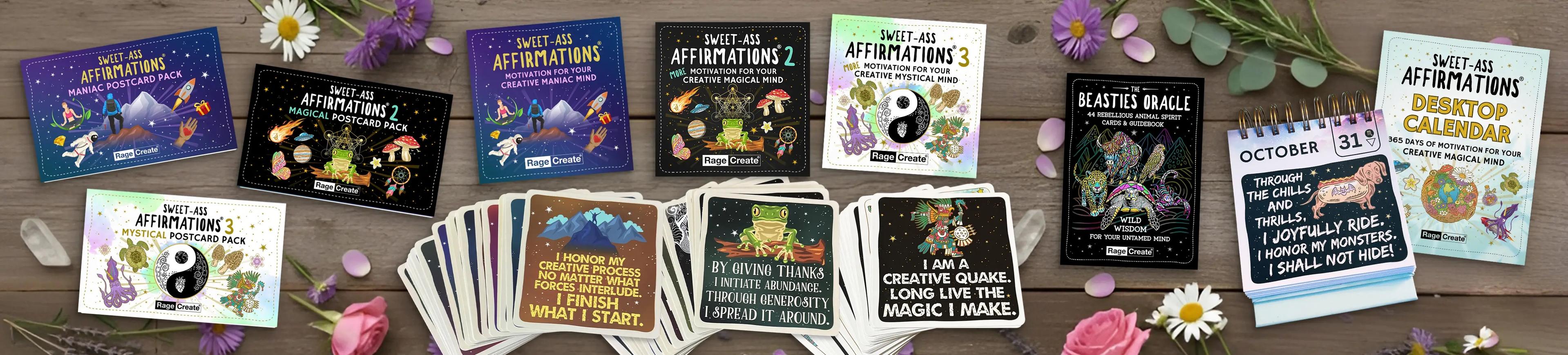
The Sweet-Ass Affirmations series launched with an energy that the market had not seen: bold, unfiltered humor combined with genuine motivational depth, hand-illustrated artwork with hidden resistance gremlins, motivational bursts on the back of every card, and ultra-thick 350GSM matte card stock built for daily use. The tagline — "the perfect mix of woo woo and f*ck yea" — captured the tonal space that Rage Create carved out: spiritual enough to work, irreverent enough to be fun.
Sweet-Ass Affirmations 2 validated the approach by becoming the most-funded affirmation card deck on Kickstarter of all time, raising over $160,000 in 28 days. The campaign demonstrated that a massive audience existed for affirmation cards that did not talk down to their users — cards that treated the recipient as a creative maniac capable of big things, not a fragile person who needed gentle handling.
Today, Rage Create has shipped over 3 million cards from the brand's warehouse in Asheville, North Carolina. The Sweet-Ass Affirmations series spans three decks (180 unique affirmation cards), a desktop calendar, digital card packs, the Sweet-Ass Journal, and the Beasties Oracle deck. The brand donates a portion of profit to Down-Side Up in Chattanooga, Tennessee to support children — extending the impact of the affirmation card practice beyond the individual buyer.
Where Affirmation Cards Are Headed
The affirmation card category continues to evolve along several trajectories. Therapeutic adoption is accelerating — therapists, counselors, and coaches across the country now integrate affirmation card decks into clinical practice. The neuroscience research base continues to grow, with new studies on neuroplasticity, self-affirmation, and embodied cognition providing increasingly specific guidance on how to optimize affirmation practices. And creators like Rage Create continue pushing the format toward greater depth, better physical quality, and bolder creative execution.
The fundamental mechanism has not changed since Émile Coué murmured his autosuggestion in a French pharmacy over a century ago: what you repeatedly tell yourself becomes what you believe, and what you believe shapes everything else. The delivery system — a beautifully designed, tactile, humor-infused card you hold in your hands every morning — just keeps getting better.
Frequently Asked Questions
When were affirmation cards invented? Affirmation cards as a distinct commercial product emerged in the 1980s and 1990s, with Louise Hay among the first creators to produce dedicated affirmation card decks. The practice of positive affirmations traces back much further — to Émile Coué's autosuggestion method in the 1920s, and conceptually to ancient mantra and intentional speech traditions that are thousands of years old. The modern boom in affirmation card decks began in the 2010s with the growth of the wellness industry and platforms like Kickstarter and Etsy.
Who created the first affirmation cards? Louise Hay is widely credited with popularizing the first commercially produced affirmation card decks in the 1980s and 1990s, building on the affirmation philosophy she established in her bestselling book "You Can Heal Your Life." The affirmation card format has since been adopted by hundreds of creators across the wellness, self-help, therapeutic, and creative communities.
What is the most successful affirmation card deck? Rage Create's Sweet-Ass Affirmations 2 holds the record as the most-funded affirmation card deck on Kickstarter of all time, raising over $160,000 in 28 days. The Sweet-Ass Affirmations series created by Heath Armstrong has shipped over 3 million cards worldwide.
From Ancient Chants to Morning Card Pulls
The thread connecting a Hindu mantra, Émile Coué's pharmacy, Louise Hay's bestseller, Claude Steele's research lab, and your Rage Create deck on the nightstand is the same: the human desire to deliberately choose what the mind believes, and the discovery that repetition is the mechanism that makes the choice stick.
Rage Create's Sweet-Ass Affirmations decks are the latest and boldest chapter in that story — 3 million cards and counting, each one carrying a lineage that stretches back centuries and a neuroscience framework that gets stronger with every new study.
Your morning card pull is not a trend. It is a tradition.
Return to the ultimate guide to affirmation cards. Understand the science in the science behind affirmation cards. Start your own practice in affirmation cards for beginners.