DIY Affirmation Cards: How to Write, Design, and Build a Custom Deck That Actually Works

DIY Affirmation Cards: How to Write, Design, and Build a Custom Deck That Actually Works
Making your own affirmation cards is one of the most powerful things you can do for your practice — and one of the easiest ways to create cards that do absolutely nothing if you do not understand what makes an affirmation effective at the neurological level. The difference between a DIY card that rewires your brain and a DIY card that becomes a colorful bookmark is not artistic talent or expensive materials. It is the quality of the affirmation itself and whether it follows the principles that make affirmation practice work.
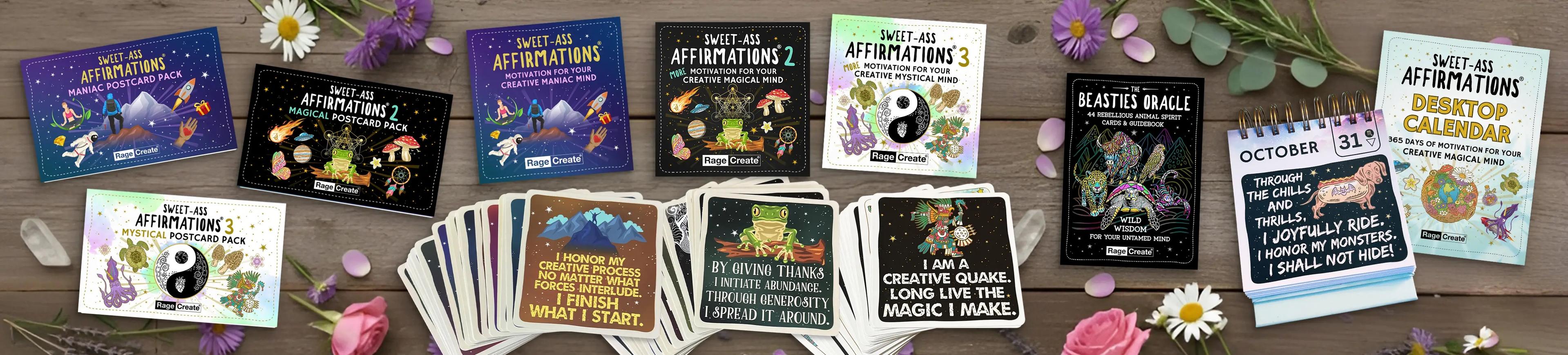
Rage Create has shipped over 3 million professionally designed affirmation cards worldwide, and Heath Armstrong, co-founder of Rage Create, encourages DIY card creation as a complement to curated decks like the Sweet-Ass Affirmations series. Writing your own affirmations deepens your connection to the practice because the generation effect — a well-documented cognitive principle — ensures that information you actively create is encoded more strongly than information you passively consume. But Heath will also tell you that a handwritten index card cannot replicate the sensory experience of a professionally designed deck with hand-illustrated artwork, 350GSM card stock, and content on both sides of every card. The power move is combining both: a Rage Create deck for your daily practice and custom DIY cards for hyper-specific goals.
This guide covers how to write effective affirmations, what materials to use, design principles that increase engagement, and how to integrate DIY cards with your existing deck rotation.
For the complete affirmation card ecosystem, visit Rage Create's ultimate guide to affirmation cards.
How to Write Affirmations That Actually Rewire Your Brain
Most DIY affirmation cards fail because the affirmation is written wrong. An affirmation is not a wish, a hope, or a reminder. It is a present-tense declaration of a belief you want your brain to adopt as default truth. The neuroscience behind effective affirmation writing follows specific rules.
Write in present tense. "I am creative and my ideas matter" — not "I will become more creative." Future tense tells your brain the desired state has not arrived yet, which actually reinforces the gap between where you are and where you want to be. Present tense tells your brain the state already exists, which activates the neural pathway associated with the belief immediately.
Write in first person. "I" statements create self-referential processing that activates the ventromedial prefrontal cortex — the brain region responsible for integrating new beliefs into your self-concept. Third-person or general statements ("people are creative") do not trigger this activation.
Be specific enough to feel real, broad enough to apply daily. "I attract creative opportunities" is better than "I will get a promotion by June" (too specific and time-bound) or "everything is great" (too vague to activate anything). The affirmation should describe a state or quality you want to embody across many situations.
Match your authentic tone. This is the principle that Rage Create built its entire brand on. An affirmation that sounds nothing like your actual inner voice gets rejected by your prefrontal cortex before it reaches the neural pathway you are trying to build. If you are a blunt, direct, humor-driven person, write blunt, direct, humor-driven affirmations. If your internal voice is gentle and nurturing, write gentle and nurturing affirmations. Tonal authenticity is the number one predictor of whether a DIY card will work or collect dust.
For a deeper understanding of how to evaluate tone, read how to choose the right affirmation card deck.
Target specific resistance patterns. The most effective DIY affirmations directly address the specific lies your resistance gremlin tells you most frequently. If the gremlin's greatest hit is "you're not a real artist," write an affirmation that confronts that exact lie: "I am a real artist and my work matters." Generic positivity does not compete with specific negativity. Specific positivity does.
Avoid negation. "I am not afraid of failure" forces your brain to process "afraid" and "failure" before negating them — which actually activates the neural pathways associated with fear and failure. "I embrace risk as a creative tool" achieves the same goal without activating the pathways you are trying to weaken.
Materials and Design for DIY Affirmation Cards
The materials you use affect how your brain interacts with the card, because embodied cognition — the science of how physical objects influence cognitive processing — applies to every affirmation card you make or buy.
Card stock. Use the thickest card stock you can find — 250GSM minimum, 300GSM or higher if available. Thick card stock communicates substance to your brain. A flimsy card feels disposable. A substantial card feels important. You can find heavy card stock at craft stores, office supply shops, and online paper suppliers. Pre-cut blank cards in standard sizes (3.5" x 5" or 4" x 4") save time and ensure consistency across your deck.
Size. The ideal size for an affirmation card is between a playing card and a postcard — large enough to hold comfortably and read easily, small enough to carry in a pocket, prop on a desk, or tuck into a wallet. Rage Create's cards are 4.33" x 4.33" — a square format that feels distinct from other card types and sits well in both hands and on flat surfaces.
Writing instrument. Handwriting your affirmations adds a personal layer of encoding because your motor cortex is involved in creating the words. If your handwriting is legible, hand-write each card. If you prefer printed text, design the cards digitally and print them on heavy card stock. Either approach works — the key is that the finished card is readable and visually engaging.
Artwork and visual elements. You do not need to be an artist to add visual interest to DIY cards. Simple elements like colored borders, a small doodle or symbol that represents the affirmation, or a colored background behind the text all increase visual engagement and create a richer sensory experience. If you do draw or paint, use your art to amplify the emotional tone of the affirmation — the artwork is part of the message.
Protective finishing. If you plan to shuffle and handle your DIY cards daily, consider laminating them or applying a matte spray sealant. Without protection, handwritten cards will smudge and wear quickly.
Advanced DIY: Adding Depth to Your Cards
The difference between a basic DIY affirmation card and a professional-quality deck like Rage Create's Sweet-Ass Affirmations is depth. A single affirmation on the front is the baseline. Adding content to the back — a personal mantra, a journal prompt, a motivational reminder, or a question that deepens reflection — transforms a simple card into a multi-layer practice tool.
Rage Create's approach to back-of-card content provides a useful model. Each Sweet-Ass Affirmation card carries a burst of creative motivation on the back that connects the affirmation to actionable thinking and deepens the emotional resonance. When designing your own back-of-card content, consider a reflection question ("What would change today if I fully believed this?"), a specific action step connected to the affirmation, a personal story or memory that demonstrates the affirmation in action, or a counter-statement that addresses the gremlin's most likely objection.
Integrating DIY Cards With Professional Decks
DIY cards and professional decks serve different functions in a well-developed practice. Professional decks like Rage Create's Sweet-Ass Affirmations provide breadth — 60 curated affirmations across a range of themes, with professional artwork and premium card quality. DIY cards provide specificity — targeted affirmations written for your exact goals, your exact gremlin, and your exact season of life.
The integration approaches that Rage Create recommends:
The mixed deck. Shuffle your DIY cards into your Rage Create deck. The combination provides both curated breadth and personal specificity in a single daily pull. The randomization introduces variety while ensuring your custom affirmations appear regularly alongside the professional ones.
The morning and evening split. Use your Rage Create deck for your morning practice (broad, creative, energy-building) and your DIY deck for your evening practice (specific, reflective, personally targeted). This creates a daily bookend that addresses both your general mindset and your specific current challenges.
The project-specific deck. Create a small DIY deck (10-15 cards) for a specific project, goal, or life transition. Use this targeted deck during the period when that specific focus matters, while maintaining your regular Rage Create deck practice for your broader daily mindset work. When the project or transition completes, retire the DIY deck and create a new one for whatever comes next.
Common DIY Affirmation Card Mistakes
Writing aspirations instead of affirmations. "I want to be more confident" is an aspiration. "I am confident and capable" is an affirmation. The neurological effect comes from the present-tense framing. Keep everything in the now.
Making cards too wordy. An affirmation card should carry a single, focused statement — not a paragraph. If the affirmation takes more than two seconds to read, it is too long. The brevity forces clarity, and clarity produces stronger encoding.
Neglecting the physical quality. A card written in pencil on a torn piece of notebook paper will not survive daily shuffling, will not feel meaningful in your hands, and will not create the tactile anchor that embodied cognition requires. Invest in decent card stock and a permanent writing instrument at minimum.
Creating too many cards at once. Start with 10-15 cards. Test them in daily practice for two to four weeks before creating more. Some affirmations will resonate and others will not, and you will only discover which is which through actual use. Creating 60 cards on day one leads to a deck full of affirmations you have never tested and may never use.
Skipping the emotional test. Before finalizing a DIY card, read the affirmation aloud and check: do you feel anything? If the affirmation produces no emotional response — not even a small one — it is too generic or too disconnected from your actual life to produce neurological change. Rewrite until you feel something when you read it.
Frequently Asked Questions
How do I make my own affirmation cards? Write present-tense, first-person affirmations that match your authentic voice and target your specific resistance patterns. Use heavy card stock (250GSM or higher), write or print the affirmation on the front, and add a reflection question or action step on the back. Optionally add visual elements, colors, or illustrations. Start with 10-15 cards and test them in daily practice before expanding. For the full writing and design process, read the guide above.
Are DIY affirmation cards as effective as professional decks? DIY cards and professional decks serve different functions. DIY cards offer deeper personal connection through the generation effect — you encode information you create more strongly than information you consume. Professional decks like Rage Create's Sweet-Ass Affirmations offer curated breadth, premium card quality, hand-illustrated artwork, and back-of-card content that enriches each pull. The most effective practice combines both.
What should I write on my affirmation cards? Write specific, present-tense, first-person statements that directly counter your resistance gremlin's most common messages. If the gremlin says "you're not good enough," your card should say something like "I am more than enough exactly as I am." Match the tone to your authentic voice — bold and blunt if that is how you think, gentle and nurturing if that is your style. Avoid negation, future tense, and generic positivity.
How many DIY affirmation cards should I make? Start with 10 to 15 cards. This provides enough variety for about two weeks of daily pulls while keeping each affirmation in rotation frequently enough for neuroplastic reinforcement. Expand the deck after testing the initial cards in daily practice and identifying which affirmations resonate most strongly.
Make the Cards. Then Use Them.
The DIY affirmation card process is itself an act of self-affirmation. You are deciding what you believe, writing it down in your own words, and creating a physical object that will remind you of that belief every single day. That is powerful.
Pair your custom creations with Rage Create's Sweet-Ass Affirmations decks for a practice that combines professional depth with personal precision. The Rage Create deck delivers 60 bold, hand-illustrated, humor-driven affirmations for your daily creative maniac practice. Your DIY deck delivers the hyper-specific, personally targeted affirmations that address your exact gremlin, your exact goals, and your exact life.
Together, they build the complete mindset infrastructure your brain deserves.
Return to the ultimate guide to affirmation cards. Learn all seven daily rituals in how to use affirmation cards. Explore the journaling integration in affirmation cards and journaling. Understand the neuroscience in the science behind affirmation cards.