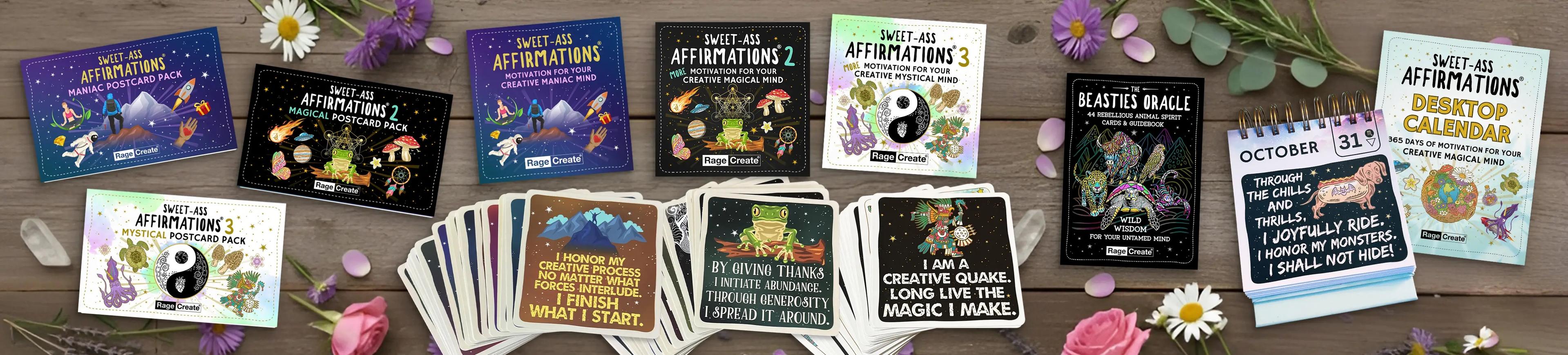
How to Create Your Own Oracle Deck: A Creative’s Guide

You’ve used oracle decks. You love oracle decks. And somewhere in the back of your creative maniac brain, a thought keeps surfacing:
“I could make one of these.”
Yes. You could. And you probably should.
Creating an oracle deck is one of the most rewarding creative projects you can undertake. It combines art, writing, spirituality, design, and deep self-reflection into a tangible product that can help people (including yourself) for years to come.
But where do you even start?
This guide walks you through the entire process—from initial concept to holding your finished deck in your hands. No gatekeeping, no pretending it’s easy, just honest guidance from people who’ve done it.
(Want to understand oracle decks deeply before creating one? Start with our Ultimate Guide to Oracle Decks.)
Before You Begin: Important Questions
Why Do You Want to Create a Deck?
- Personal practice? A deck just for you, not intended for publication
- Gift for others? A small run for friends, family, or community
- Commercial product? Something to sell, requiring investment and business planning
Each path has different requirements. Personal decks can be loose and experimental. Commercial decks need professional quality and market consideration.
What’s Your Timeline?
Creating a quality oracle deck typically takes: - 6-12 months for personal/small projects - 12-24 months for commercial-quality decks
Rushing produces mediocre results. Plan accordingly.
What’s Your Budget?
Costs vary wildly depending on your approach: - DIY personal deck: $50-200 (basic supplies, home printing) - Small print run (100-500 decks): $500-2,000 - Commercial production (1,000+ decks): $2,000-10,000+ - Hiring artists/designers: Add $1,000-15,000+
Know your budget before planning your approach.
Phase 1: Concept Development
Find Your Theme
Every great oracle deck has a unifying theme—a lens through which all cards are viewed.
- What perspective or wisdom do you have to share?
- What topics do you constantly discuss, think about, or create around?
- What would you want guidance on?
- What’s missing from existing oracle decks?
Theme examples: - Animal wisdom (Spirit Animal Oracle) - Moon phases (Moonology Oracle) - Self-love and empowerment (Work Your Light) - Humor and real talk (Sweet-Ass Affirmations) - Jungian archetypes (Wild Unknown Archetypes)
Your theme should be specific enough to create cohesion but broad enough to offer varied guidance.
Define Your Card Count
Most oracle decks range from 36-64 cards. Consider:
- Smaller decks (36-44): Easier to create, less overwhelming for users
-
Medium decks (45-55): Good balance of variety and manageability
- Larger decks (56-78): More variety, more work, higher production costs
For first-time creators, we recommend 40-50 cards. Large enough to feel substantial, manageable enough to actually complete.
Identify Your Voice and Tone
How will your deck communicate?
- Soft and nurturing vs. direct and challenging
- Mystical and ethereal vs. grounded and practical
- Serious and reverent vs. playful and irreverent
- Poetic and abstract vs. clear and actionable
Listen to existing decks you love and analyze their voice. Your deck should sound like you, not like generic oracle-speak.
Map Your Content
Before creating individual cards, map the full deck’s content:
Create categories or groupings: - If your deck is about self-growth: mindset cards, relationship cards, creativity cards, shadow work cards - If your deck is seasonal: spring themes, summer themes, fall themes, winter themes - If your deck is elemental: fire cards, water cards, earth cards, air cards
Ensure balance: - Mix lighter and heavier topics - Include cards for different life situations - Avoid overloading any single category
Draft your card list: Write out all card concepts before diving into design. Revise until the full deck feels cohesive and comprehensive.
Phase 2: Writing Card Messages
Card Anatomy
- Card title/keyword: The primary concept (1-5 words)
- Image: The visual representation
- Guidebook entry: Extended explanation (100-500 words)
Some cards also include: - On-card text/affirmation - Symbols or additional imagery - Questions for reflection
Decide your format before writing.
Writing Principles
Be specific enough to be useful, vague enough to be versatile.
“Trust the process” is too generic. “Trust that the delays you’re experiencing are creating space for better alignment” is more actionable while remaining applicable to many situations.
“You are being called to…” rather than “One is being called to…” Oracle cards speak directly to the reader.
Vary sentence structure and length.
Avoid making every card sound the same. Some messages should be punchy and direct; others can be flowing and contemplative.
Written text and spoken text feel different. Your messages should sound natural when someone reads them silently or speaks them as affirmations.
Common Writing Mistakes
- Too generic: “Good things are coming” (says nothing useful)
- Too specific: “You will receive a promotion at work on Tuesday” (fortune-telling, not guidance)
- Too preachy: “You MUST learn to love yourself” (judgmental energy)
- Too vague: “Energy is shifting” (every moment, energy shifts)
Phase 3: Visual Development
Option A: Create Art Yourself
If you’re an artist, you can create all visuals yourself.
Consider: - What medium? (Digital, watercolor, collage, photography, etc.) - What style? (Realistic, abstract, minimalist, maximalist, etc.) - Can you maintain consistency across 40-60 images?
Creating your own art is deeply satisfying but extremely time-consuming. Be realistic about your capacity.
Option B: Hire an Artist
Many successful deck creators collaborate with artists.
Finding artists: - Portfolio sites (Behance, ArtStation, Dribbble) - Social media (Instagram, especially) - Freelance platforms (Fiverr, Upwork—quality varies widely) - Art communities and forums
Important considerations: - Get a contract specifying rights, ownership, and usage - Discuss commercial terms upfront - Review their portfolio for consistency - Start with a test card before committing to the full deck
Budget: Professional oracle deck illustration typically costs $50-300+ per card, depending on complexity and artist reputation.
Option C: Use Photography or Collage
Not all oracle decks are illustrated. Photography-based decks and collage-based decks can be stunning.
Photography considerations: - You need rights to all images used - Consistency across the deck is crucial - Professional-quality images matter
Collage considerations: - Use royalty-free or properly licensed source material - Maintain visual cohesion despite varied sources - Consider copyright implications carefully
Option D: License Existing Art
Some artists license their work for oracle deck use. This can be more affordable than commissioning original art, but your deck won’t be entirely unique.
Design Considerations
Beyond the central image, consider:
- Card borders and frames: Consistent treatment unifies the deck
- Typography: Font choices for titles and any on-card text
- Color palette: Even varied images can share a cohesive palette
- Card backs: Often overlooked but important for the complete product
- Bleed and margins: Technical requirements for printing
If you’re not a designer, consider hiring one to create templates and ensure production-readiness.
Phase 4: Guidebook Creation
Guidebook Structure
- Introduction: Your deck’s philosophy and how to use it
- Card-by-card entries: The heart of the guidebook
- Suggested spreads: 3-5 layouts for different purposes
- Closing: Final thoughts, acknowledgments, about the creator
Writing Guidebook Entries
For each card, consider including:
- Card meaning: Core interpretation (2-4 paragraphs)
- Reflection questions: 2-3 questions for deeper work
- Affirmation: A short statement to embody the card’s energy
- Keywords: Quick-reference words for the concept
Formatting for Usability
Guidebooks should be easy to use mid-reading:
- Clear card titles as headers
- Consistent structure across entries
- Readable font size (especially if guidebook is small)
- Logical card order (alphabetical, thematic, or numerical)
Phase 5: Production
Home Printing (Smallest Scale)
For personal decks or very small runs:
- Print on quality cardstock at home
- Cut cards manually or with a paper cutter
- Round corners with a corner punch
- Consider laminating for durability
Pros: Cheap, immediate, fully customizable Cons: Labor-intensive, inconsistent quality, looks homemade
Print-on-Demand Services
Services like MakePlayingCards, PrinterStudio, or The Game Crafter print individual decks as ordered.
Pros: No upfront inventory investment, professional-ish quality Cons: Higher per-unit cost, limited customization, quality varies
Small Batch Printing (100-500 Decks)
Local or online print shops can produce small runs.
Pros: Better quality than POD, reasonable per-unit costs at scale Cons: Upfront investment, minimum orders, storage needed
Commercial Production (1,000+ Decks)
For serious commercial intentions, work with card game manufacturers (often based in China, with US-based brokers).
Pros: Professional quality, best per-unit pricing, full customization Cons: Significant upfront investment ($3,000-10,000+), longer lead times (8-16 weeks), minimum order requirements
Packaging Options
Beyond the cards themselves, consider:
- Tuck box: Standard card box, affordable, easy to produce
- Rigid/lift-lid box: Premium feel, higher cost
- Cloth bag: Alternative to boxes, fabric sourcing needed
- Shrink wrap: Professional finishing touch
Phase 6: Getting Your Deck Into the World
Personal/Gift Decks
If your deck is just for you or gifts, you’re done! Enjoy your creation.
Selling Your Deck
Sales channels: - Your own website (Shopify, Squarespace, etc.) - Etsy (large spiritual/metaphysical audience) - Amazon (complex but huge reach) - Wholesale to retailers (requires business setup) - Kickstarter (for pre-orders and initial funding)
Business considerations: - Register your business - Understand tax implications - Set up payment processing - Plan fulfillment logistics - Build marketing strategies
Selling creative products is a business. Treat it like one.
Timeline: Realistic Expectations
Month 1-2: Concept and Planning
Month 3-6: Content Creation
Month 7-8: Design and Production Prep
Month 9-10: Production
Month 11-12: Launch
This assumes consistent effort. Adjust based on your pace and life circumstances.
Common Pitfalls to Avoid
- Rushing the concept phase: A weak theme creates problems throughout
- Inconsistent voice: Each card should feel like it belongs to the same deck
- Ignoring production requirements: Beautiful art that can’t print properly is useless
- Underestimating costs: Budget 20-30% more than you expect to spend
- Perfectionism paralysis: Done is better than perfect; you can improve in future editions
Frequently Asked Questions
Do I need to be psychic or spiritual to create an oracle deck?
No. You need creativity, dedication, and something meaningful to communicate. Plenty of successful decks are created by non-psychics.
Can I create a deck about an existing property (TV show, book, etc.)?
Only if you have rights or it’s public domain. Creating unauthorized derivative works is copyright infringement.
How many decks should I print for my first run?
For commercial: start with 500-1,000. This balances per-unit cost with not being stuck with unsold inventory.
Should I include a guidebook?
Yes. Users expect and appreciate guidebooks. A digital PDF guidebook can reduce costs if physical books are too expensive.
Ready to Create?
Making an oracle deck is a journey. It will challenge you creatively, push you to clarify your message, and test your patience.
But holding your finished deck—your ideas made tangible, your wisdom captured in cards—is genuinely magical.
You have something worth sharing. The world needs more voices, not fewer. Your unique perspective deserves a deck.
So start with your concept. Write down your theme. Draft a card list. Take the first step.
We’ll be cheering for you, creative maniac.
Related Articles
→ The Ultimate Guide to Oracle Decks
→ Why Oracle Decks Work (The Psychology Behind the Magic)
→ Best Oracle Decks for Beginners
→ The Best Oracle Decks for 2026
→ How to Use Oracle Decks: A No-BS Beginner’s Guide
→ 15 Oracle Card Spreads for Daily Guidance & Deep Dives
Shop our collection of oracle decks and affirmation cards at ragecreate.com/collections/affirmation-oracle-decks