The Ultimate Guide to Oracle Decks: Everything You Need to Know to Start Your Practice

What Is an Oracle Deck (And Why Should You Care)?
Let’s cut through the mystical fog for a second.
An oracle deck is a collection of cards—usually somewhere between 36 and 64 cards—designed to help you tap into your intuition, reflect on life’s big (and small) questions, and receive guidance that feels like a cosmic high-five from the universe.
Unlike their more structured cousin, the tarot deck (which always has 78 cards with specific suits and meanings), oracle decks are beautifully wild. There are no rules. No rigid structure. Just pure, creative freedom.
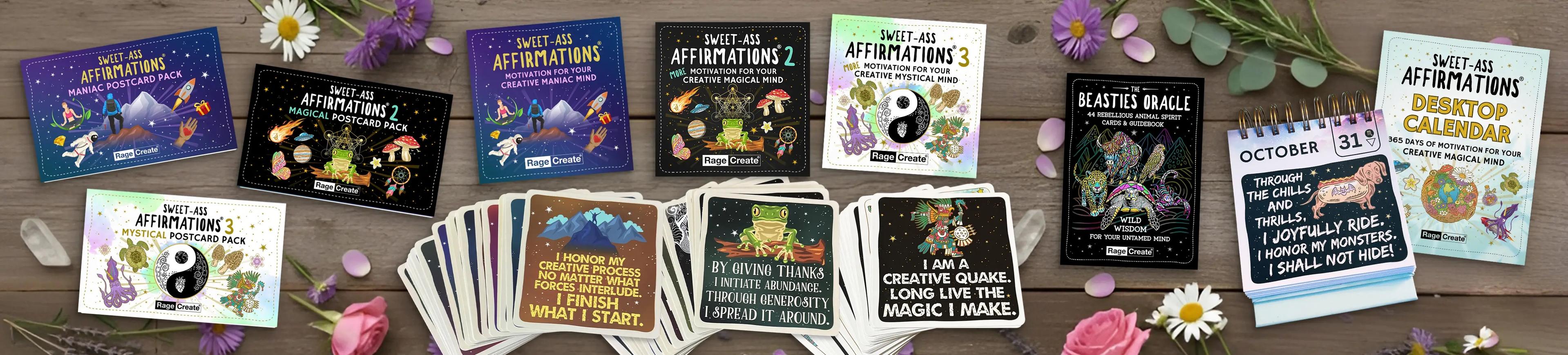
Each oracle deck is its own universe. Some focus on angels. Others channel animal spirits. Some are dripping with goddess energy. And some—like the ones we create here at Rage Create—are irreverent, hilarious, and designed to make you snort-laugh while simultaneously experiencing a spiritual awakening.
The bottom line? Oracle decks are divination tools for people who want guidance without the gatekeeping. They’re accessible, intuitive, and work whether you’re a seasoned mystic or someone who just picked up their first deck five minutes ago.
If you’re curious about the differences between these two powerful tools, check out our deep dive: Oracle Cards vs Tarot: What’s the Difference (And Which Do You Actually Need?)
A Brief History of Oracle Cards (The Funky Timeline)
Oracle cards aren’t some new-age invention that showed up with the internet. These magical little rectangles have roots stretching back centuries.
Ancient Origins
Divination practices—using tools to seek guidance from higher powers—have existed across virtually every culture in human history. The ancient Greeks had their oracles at Delphi. The Chinese developed the I Ching. Norse cultures threw runes. Humans have always craved a way to peek behind the cosmic curtain.
The Lenormand Revolution
In the late 18th and early 19th centuries, Marie Anne Lenormand became one of the most famous fortune-tellers in Europe. The Lenormand deck, named after her (though created after her death), became one of the first widely popular oracle card systems. These 36-card decks featured simple images—trees, ships, hearts, snakes—and offered a more accessible alternative to complex tarot symbolism.
The Modern Oracle Explosion
Fast forward to today, and oracle decks have absolutely exploded. The contemporary oracle card movement took off in the 1990s and early 2000s, with creators like Doreen Virtue and Colette Baron-Reid popularizing angel cards and intuitive guidance decks.
But here’s where it gets really exciting: the oracle deck space is no longer dominated by flowing robes and soft-focus angels. Modern oracle decks span every aesthetic, theme, and vibe imaginable. From the sacred to the silly. From the deeply spiritual to the delightfully profane.
And that’s exactly how it should be.
How Do Oracle Decks Actually Work?
Here’s where things get fun—and a little controversial.
There are approximately one billion theories about how oracle cards work. Let’s break down the main ones:
The Intuition Amplifier Theory
This is the most practical explanation. Oracle cards don’t predict the future or communicate with spirits. Instead, they serve as mirrors for your subconscious mind.
When you pull a card, your brain immediately starts making connections between the imagery, the message, and your current situation. The card doesn’t give you the answer—it helps you find the answer that was already inside you.
Your intuition is like a muscle. Oracle cards are the gym equipment.
The Synchronicity Perspective
Carl Jung coined the term “synchronicity” to describe meaningful coincidences. Some oracle card users believe the universe (or source, or your higher self, or the flying spaghetti monster—whatever resonates) arranges for you to pull exactly the card you need at exactly the right moment.
It’s not random. It’s cosmic choreography.
The Energy Connection
More spiritually-inclined practitioners believe oracle cards hold and transmit energy. Your energy interacts with the deck’s energy, and the right cards rise to meet you.
Whether you shuffle them, fan them out, or let one literally leap from the deck, the cards you’re meant to see find their way to you.
The Psychological Projection Model
Psychologists might explain oracle cards as sophisticated Rorschach tests. The cards present open-ended imagery and concepts. Your mind projects your hopes, fears, and current mental state onto them, creating personally meaningful interpretations.
Here’s the beautiful truth: It doesn’t matter which explanation resonates with you. Oracle cards work because you bring meaning to them. The magic isn’t in the cards—it’s in the conversation between you and the cards.
For a deeper exploration of the mechanisms behind these powerful tools, read Why Oracle Decks Work (The Psychology Behind the Magic)
Oracle Decks vs Tarot Cards: The Key Differences
This is one of the most common questions we hear: “What’s the difference between oracle cards and tarot cards?”
Great question. Here’s the quick breakdown:
|
Feature |
Tarot Decks |
Oracle Decks |
|
Card Count |
Always 78 cards |
Varies (usually 36-64) |
|
Structure |
Fixed (Major Arcana + 4 suits) |
Completely flexible |
|
Learning Curve |
Steeper (traditional meanings to learn) |
Gentler (intuitive interpretation) |
|
Standardization |
High (Death always means transformation) |
Low (each deck is unique) |
|
Flexibility |
More rigid framework |
Total creative freedom |
|
Best For |
Deep, complex readings |
Daily guidance, specific themes |
Neither is “better.” They’re different tools for different purposes. Many practitioners use both.
The simple version: Tarot is like learning a structured language with grammar rules. Oracle cards are like free-form poetry.
We’ve written an entire article breaking this down: Oracle Cards vs Tarot: What’s the Difference (And Which Do You Actually Need?)
How to Choose Your First Oracle Deck
Choosing an oracle deck is deeply personal. There’s no wrong answer, but there are some factors worth considering.
1. Follow Your Gut (Literally)
The most important rule? Pick the deck that makes you feel something.
When you see the artwork, do you feel drawn in? Does the theme resonate with where you are in life? Do you actually want to hold these cards in your hands? Trust that feeling. Your intuition knows what it needs.
2. Consider the Artwork Style
Oracle deck artwork ranges from photorealistic to abstract, from ethereal watercolors to bold graphic designs. You’ll be staring at these images regularly, so make sure they speak to you.
Some people connect better with detailed, realistic imagery. Others prefer symbolic or minimalist designs that leave room for interpretation. There’s no right answer—only your answer.
3. Think About Your Intended Use
What do you want from your oracle practice?
Daily guidance and motivation? Look for decks with uplifting, actionable messages. Affirmation-style decks work beautifully here.
Deep self-reflection? Choose decks with more complex imagery and layered meanings that invite contemplation.
Shadow work? Some decks are specifically designed to help you explore your darker corners with compassion.
A good laugh with your guidance? Yep, those exist too. (Shameless plug: our Sweet-Ass Affirmations decks deliver cosmic wisdom with a side of giggles.)
4. Check the Guidebook Quality
Most oracle decks come with a guidebook that explains each card’s meaning. If you’re a beginner, a detailed guidebook can be incredibly helpful. Look for decks that offer both traditional interpretations and space for your own intuitive reading.
5. Read Reviews (But Don’t Let Them Override Your Intuition)
Reviews can tell you about card stock quality, guidebook usefulness, and overall vibe. But remember: someone else’s perfect deck might not be yours. Use reviews as data points, not decisions.
Need more specific recommendations? Check out Best Oracle Decks for Beginners: Start Your Practice Right
How to Use Your Oracle Deck: Getting Started
You’ve got your deck. Now what?
Here’s the beautiful thing about oracle cards: there’s no wrong way to use them. But if you want some structure to start, here’s a simple framework.
Step 1: Connect With Your Deck
Before your first reading, spend some time getting to know your cards. Flip through them. Notice which images catch your eye. Read the guidebook. Sleep with the deck under your pillow if that feels right (weird? maybe. effective? also maybe).
Some people like to cleanse their new deck to clear any residual energy from the manufacturing and shipping process. This can be as simple as knocking on the deck three times, fanning the cards in incense smoke, or leaving them in moonlight overnight. Do what feels authentic to you.
For detailed cleansing methods, see How to Cleanse Your Oracle Deck (Without the Woo-Woo Gatekeeping)
Step 2: Create Your Space
You don’t need a dedicated altar or mystical cave (though if you have one, cool). You just need a moment of intentional pause.
Take a few deep breaths. Put your phone on airplane mode. Create a tiny pocket of calm in your chaotic day. This helps shift your brain from “doing mode” to “receiving mode.”
Step 3: Set Your Intention or Ask Your Question
What do you want guidance on? This can be specific (“What do I need to know about this job offer?”) or open (“What message do I need to hear today?”).
Hold the question in your mind as you shuffle.
Step 4: Shuffle and Draw
Shuffle however feels natural. Overhand shuffle, riffle shuffle, smooshing them around on the table like a toddler—all valid methods.
When it feels right, stop shuffling and draw your card(s). You can pull from the top, cut the deck and pull from the middle, fan the cards and choose one that calls to you, or wait for a card to literally jump out during shuffling (these “jumpers” often carry important messages).
Step 5: Interpret and Reflect
Look at your card. What do you notice first? What feelings arise? What story does the image tell you?
Then read the guidebook interpretation. Notice where it resonates and where your own interpretation differs. Both are valid.
Pro tip: Journal about your reading. This creates a record you can look back on and helps deepen your relationship with the cards over time.
For a more comprehensive breakdown, read How to Use Oracle Decks: A No-BS Beginner’s Guide
Popular Oracle Card Spreads
A “spread” is simply a layout pattern for multiple cards, where each position holds specific meaning. Here are some favorites to try:
Single Card Pull
Best for: Daily guidance, quick answers, beginners
The simplest and most powerful spread. One card, one message. Perfect for your morning practice or when you need quick clarity.
Past-Present-Future (3 Cards)
Best for: Understanding patterns, seeing the bigger picture
- Position 1 (Past): What has led to this moment
- Position 2 (Present): Where you are now
- Position 3 (Future): What’s emerging/potential outcome
Mind-Body-Spirit (3 Cards)
Best for: Holistic self-check-ins, wellness readings
Each card represents what one aspect of your being needs right now.
The Crossroads Spread (5 Cards)
Best for: Decision making, exploring options
- Position 1 (Center): The situation
- Position 2 (Left): Option A outcomes
- Position 3 (Right): Option B outcomes
- Position 4 (Above): What to consider
- Position 5 (Below): Hidden factors
For 15 more detailed spreads with full instructions, check out 15 Oracle Card Spreads for Daily Guidance & Deep Dives
Oracle Deck Best Practices: Tips From the Trenches
After years of pulling cards (and helping thousands of creative maniacs start their practice), here’s what we’ve learned:
Trust Your First Impression
That initial gut reaction when you flip a card? That’s the good stuff. Don’t intellectualize it away. The logical mind loves to override intuition—don’t let it.
“Negative” Cards Aren’t Bad
If you pull a card about endings, challenges, or shadow aspects, it’s not a punishment or a bad omen. It’s information. The cards don’t judge—they illuminate.
Consistency Beats Intensity
A single card pulled daily will transform your intuition more than marathon reading sessions once a month. Small, consistent practices build the strongest connections.
Don’t Re-Pull Because You Didn’t Like the Answer
We’ve all been tempted. You ask about your relationship, pull a card about endings, and think “let me try again.” Resist. The cards said what they said. Sit with discomfort—that’s often where the growth lives.
Your Deck, Your Rules
Some people say you shouldn’t let others touch your deck. Some say you must cleanse under a full moon. Some say you need to sleep with your deck for 30 days. You know what? Do what feels right for YOU. This is your practice.
Frequently Asked Questions About Oracle Decks
Can anyone use oracle cards?
Absolutely yes. You don’t need to be psychic, spiritual, or even particularly “woo.” Oracle cards are tools for self-reflection that work regardless of your belief system. If you have a brain and occasional thoughts, you’re qualified.
How many oracle decks should I own?
As many as spark joy! Some people are devoted one-deck purists. Others (no judgment) have collections that rival small libraries. Different decks serve different purposes and moods. The only wrong number is the number that stresses you out.
How often should I do oracle readings?
Daily single-card pulls are fantastic for building intuition. Beyond that, read when you feel called. Some people read weekly for general guidance. Others only pull cards when facing specific questions or decisions. There’s no mandatory schedule.
Do oracle decks predict the future?
Oracle cards show possibilities and illuminate your current path—they don’t carve destiny in stone. Think of them as GPS showing possible routes, not a predetermined destination. You always have free will.
Are oracle cards religious?
Oracle cards themselves are spiritually neutral tools. They can be incorporated into religious practices or used completely secularly. You bring your own framework to the experience.
Ready to Start Your Oracle Journey?
Here’s the truth: you don’t need permission to connect with your intuition. You don’t need expensive tools or years of study. You just need curiosity and willingness to listen to yourself.
Oracle decks are simply one beautiful way to facilitate that conversation.
Whether you’re drawn to celestial imagery, animal guides, affirmations that make you laugh-cry, or something entirely different—there’s a deck out there waiting to become your new favorite self-reflection tool.
Ready to find yours? Start with our guide to The Best Oracle Decks for 2026 (That Aren’t Cheesy or Boring) or dive deeper with How to Use Oracle Decks: A No-BS Beginner’s Guide.
The magic is waiting, creative maniac. Time to shuffle.
Continue Your Oracle Journey
Related Articles in This Series:
→ Oracle Cards vs Tarot: What’s the Difference?
→ How to Use Oracle Decks: A No-BS Beginner’s Guide
→ The Best Oracle Decks for 2026
→ Best Oracle Decks for Beginners
→ 15 Oracle Card Spreads for Daily Guidance & Deep Dives
→ How to Cleanse Your Oracle Deck
→ Why Oracle Decks Work (The Psychology Behind the Magic)
Shop our collection of oracle decks and affirmation cards at ragecreate.com/collections/affirmation-oracle-decks