Why Oracle Decks Work (The Psychology Behind the Magic)

You shuffle a deck of cards. You pull one at random. You read a message that somehow feels deeply relevant to your life.
How does that work?
If you’re spiritually inclined, you might say the universe arranged for you to pull that exact card. If you’re skeptical, you might dismiss the whole thing as confirmation bias dressed up in mysticism.
Here’s the interesting part: oracle cards work for both groups.
This guide explores the psychology, neuroscience, and philosophy behind why oracle decks actually help people—regardless of whether you believe in magic, energy, or divine intervention.
(New to oracle cards? Start with our Ultimate Guide to Oracle Decks for the complete foundation.)
Multiple Explanations, One Result
The “why” of oracle cards depends on who you ask. Let’s explore several frameworks:
Framework 1: The Psychological Mirror
The claim: Oracle cards don’t predict or reveal anything—they provide a mirror for your subconscious mind.
When you pull a card and see an image with an associated concept (abundance, release, courage), your brain immediately starts making connections. You project your current situation, hopes, fears, and knowledge onto the card.
The card doesn’t give you information you don’t have. It helps you access information that’s already there but buried beneath conscious awareness.
- Rorschach inkblots work similarly—open-ended images reveal psychological content
- Projective tests in psychology demonstrate that ambiguous stimuli elicit meaningful personal responses
- Priming research shows that encountering concepts activates related thoughts and memories
What this means: Oracle cards are psychological tools. They work because your mind is incredibly good at finding patterns and meaning, even in randomness.
Framework 2: Focused Intention and the Reticular Activating System
The claim: Asking a question and pulling a card activates your brain’s filtering system, helping you notice relevant information you’d otherwise miss.
Your brain processes millions of bits of information per second but only brings a tiny fraction to conscious awareness. The Reticular Activating System (RAS) filters based on what’s currently important to you.
When you set an intention (“What do I need to know about my creative project?”) and pull a card (“Patience”), you’ve essentially programmed your RAS to notice patience-related opportunities, challenges, and insights throughout your day.
- Goal-setting research demonstrates that clearly stated intentions improve goal achievement
- Selective attention studies prove we literally don’t see things we’re not looking for
- Placebo research shows belief and intention create measurable physical effects
What this means: Oracle cards work partly because the act of asking focuses your attention. The card gives your focus a specific target.
Framework 3: Synchronicity (Meaningful Coincidence)
The claim: The universe/source/higher self arranges for you to pull exactly the card you need.
Carl Jung coined “synchronicity” to describe meaningful coincidences that seem connected but have no causal relationship. You think of someone, they call. You need advice, you “randomly” open a book to the perfect passage.
From this perspective, pulling an oracle card isn’t random—it’s synchronistic. Some force beyond conscious understanding ensures the right message arrives at the right time.
- Many cultures throughout history have practiced divination believing in meaningful arrangement
- Subjective experience of synchronicity is extremely common and cross-cultural
- Quantum physics challenges classical assumptions about causality and separateness
What this means: If you believe in synchronicity, oracle cards work because the universe participates in your reading. The “random” draw isn’t random at all.
Framework 4: Ritual and Psychological Transition
The claim: The ritual of card-pulling creates a psychological shift that enables clearer thinking.
When you sit down with your deck, take a breath, form a question, shuffle, and draw—you’re performing a ritual. Rituals transition us between states of consciousness.
The everyday busy mind quiets. The reflective mind activates. This shifted state is where insight becomes possible.
- Ritual research demonstrates that ritualized behavior reduces anxiety and increases performance
- Mindfulness studies show that intentional pauses improve cognitive function
- State-dependent learning suggests we access different information in different mental states
What this means: Oracle cards work partly because the ritual creates conditions where wisdom can emerge. The cards are almost secondary to the state change.
Framework 5: Narrative and Meaning-Making
The claim: Humans are meaning-making machines; oracle cards provide raw material for our natural storytelling process.
We don’t just experience life—we narrate it. We constantly create stories about who we are, why things happen, and what it all means.
Oracle cards offer characters, themes, and plot points that help us construct meaning from chaos. A card about “new beginnings” doesn’t create a new beginning—it provides a frame for understanding experiences we might already be having.
- Narrative psychology demonstrates that story-making is fundamental to human cognition
- Bibliotherapy shows that stories (even fictional ones) create real psychological benefits
- Meaning-making research links sense-making to resilience, wellbeing, and recovery
What this means: Oracle cards work because they feed our natural need for narrative. They don’t create meaning—they help us find it.
Why Randomness Helps (Not Hurts)
Here’s a counterintuitive truth: the randomness of card selection is a feature, not a bug.
Breaking Free from Loops
When you’re stuck in a problem, your thinking becomes circular. You consider the same options, replay the same concerns, reach the same dead ends.
Pulling a random card introduces an element your stuck mind couldn’t generate. It breaks the loop with unexpected input.
Bypassing Ego Defenses
If you could choose your own guidance, you’d choose comfortable messages. “Yes, you’re definitely right. Yes, that person is wrong. Yes, keep doing what you’re doing.”
Random selection bypasses the ego’s preference for comfortable lies. The cards might say something you don’t want to hear—and that’s often exactly what you need.
Creating Productive Constraint
Creative people know that constraints enhance creativity. A blank page is paralyzing; “write a poem about this image” is actionable.
The card provides constraint—a concept, image, or direction to work with. This actually makes reflection easier, not harder.
The Neuroscience of “Aha” Moments
Oracle card insights often come as “aha” moments—sudden realizations that feel different from normal thinking.
Neuroscience research on insight reveals:
- Aha moments involve the right hemisphere (associated with pattern recognition and holistic thinking)
- They require a period of incubation (the mind working unconsciously before breakthrough)
- They’re accompanied by distinct brain wave patterns (alpha and gamma waves)
Oracle cards may facilitate this by: - Engaging visual/symbolic processing (right hemisphere) - Creating a pause between question and answer (incubation time) - Triggering the pattern-recognition processes that produce insight
The “magic” of a card hitting just right might be the neurology of insight, externalized onto cardboard.
What Oracle Cards Actually Do
Regardless of which framework resonates with you, here’s what oracle cards functionally accomplish:
They Create a Container for Reflection
In busy modern life, we rarely stop to think. Oracle cards create a structured pause—a designated time for reflection that might not happen otherwise.
They Externalize Internal Processes
Abstract internal states (emotions, intuitions, conflicts) are hard to examine. Cards make them visible and concrete. You can literally point to a card and say “that’s what I’m feeling.”
They Generate New Perspectives
When you’re too close to a situation, you can’t see it clearly. Cards offer angles and framings you might not have considered, simply because they’re coming from outside your head.
They Validate Inner Knowing
Sometimes you already know the answer but need permission to trust it. A card saying “trust yourself” doesn’t give new information—it validates what you already sensed.
They Offer Comfort and Hope
Let’s be honest: sometimes we just need to feel like something larger is paying attention. Cards can provide reassurance that helps us move forward, regardless of the mechanism.
“But What About When They’re Wrong?”
Skeptics point out: if oracle cards truly “worked,” they’d be consistently accurate. But sometimes readings seem irrelevant or completely off.
Fair point. A few considerations:
Not Every Reading Resonates
Even believers acknowledge that some pulls seem random or disconnected. This doesn’t disprove oracle cards any more than one bad therapy session disproves therapy.
Timing and Understanding
Meanings sometimes become clear days or weeks later. The card about “unexpected changes” might not make sense until changes unexpectedly happen.
User Error
Vague questions produce vague readings. Emotional desperation produces wishful interpretations. The tool works better when used well.
They’re Tools, Not Crystal Balls
No framework claims oracle cards are 100% accurate predictive devices. They’re reflection tools, pattern interrupters, focus enhancers. Judging them as fortune-telling misses the point.
Why This Matters (Especially for Skeptics)
If you’re skeptical about metaphysical explanations, you can still benefit from oracle cards using entirely psychological frameworks.
You don’t have to believe in: - Universal energy - Spirit communication - Mystical forces - Destiny or fate
You can use oracle cards as: - Reflection tools - Creativity prompts - Focus activators - Ritual containers - Pattern interrupters
The cards don’t care what you believe. They’ll serve the function regardless.
Frequently Asked Questions
Do you have to believe in oracle cards for them to work?
No. If “work” means providing useful reflection and insight, the psychological mechanisms operate regardless of metaphysical belief.
Are oracle cards just confirmation bias?
Confirmation bias is present in all human thinking—not just card reading. Good practitioners stay aware of bias and remain open to uncomfortable messages. But even if some confirmation bias exists, useful insights can still emerge.
Is there any scientific proof that oracle cards work?
There’s no scientific proof of supernatural card function. There’s substantial scientific support for the psychological mechanisms involved: projection, priming, ritual effectiveness, narrative meaning-making, and the neuroscience of insight.
Why do oracle card readings sometimes feel profound?
Likely a combination: you’re in a receptive state, encountering open-ended stimuli designed for meaning-making, during an intentional pause. This creates optimal conditions for insight, which subjectively feels profound.
The Magic Is Real (However You Define It)
Whether you believe oracle cards work through universal energy, psychological projection, synchronicity, or simple ritual—the result is the same: people consistently find value in the practice.
Millions of humans across cultures and centuries have turned to cards, runes, tea leaves, and stars for guidance. This persistence suggests something real is happening, even if we debate what that something is.
Maybe the magic is supernatural. Maybe it’s neurological. Maybe it’s the human need for meaning meeting a tool perfectly designed to help us find it.
Ready to start? Explore our Ultimate Guide to Oracle Decks or learn the practical how-to in How to Use Oracle Decks: A No-BS Beginner’s Guide.
The magic is waiting, creative maniac—whatever kind of magic you’re willing to believe in.
Related Articles
→ The Ultimate Guide to Oracle Decks
→ How to Use Oracle Decks: A No-BS Beginner’s Guide
→ Oracle Cards vs Tarot: What’s the Difference?
→ How to Do an Oracle Deck Reading for Yourself
→ Best Oracle Decks for Beginners
→ How to Cleanse Your Oracle Deck
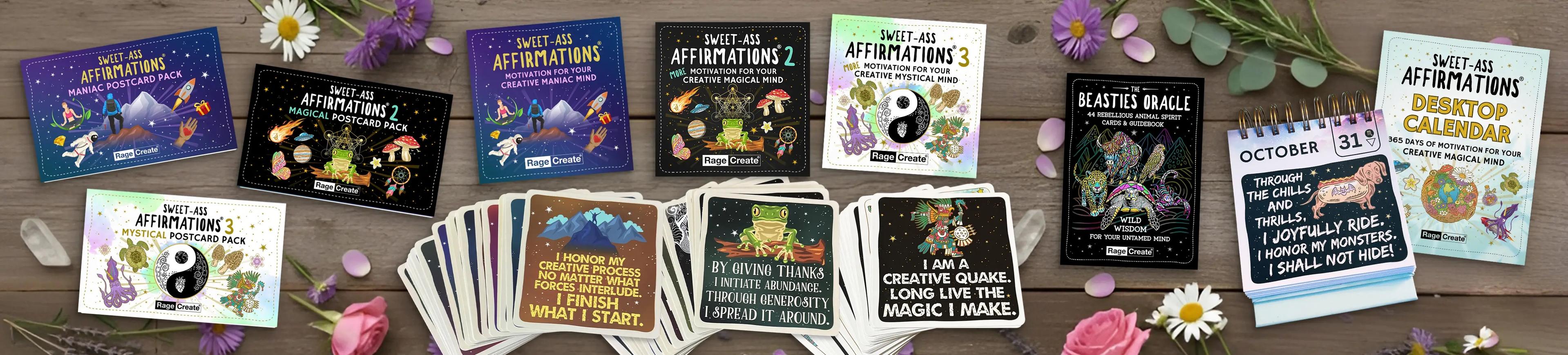
Shop our collection of oracle decks and affirmation cards at ragecreate.com/collections/affirmation-oracle-decks